
select
navigate
switch tabs
Esc close

Layered manufacturing plastic injection price performance

0
e
1

After how many productions does the price difference between layered manufacturing and plastic injection optimize?

Automatically translated from: Türkçe
See original
Solved by Durmuş Yılmaz

Hello,

As you would appreciate, this is not simply a "after so many units" answer. In fact, we need to look at a number of factors such as part geometry, required delivery time, and material to be used to choose the most cost-effective production method.

  • In plastic injection, the mold cost decreases as it is divided by the number of parts produced. So, the more you produce, the more advantageous it will become.
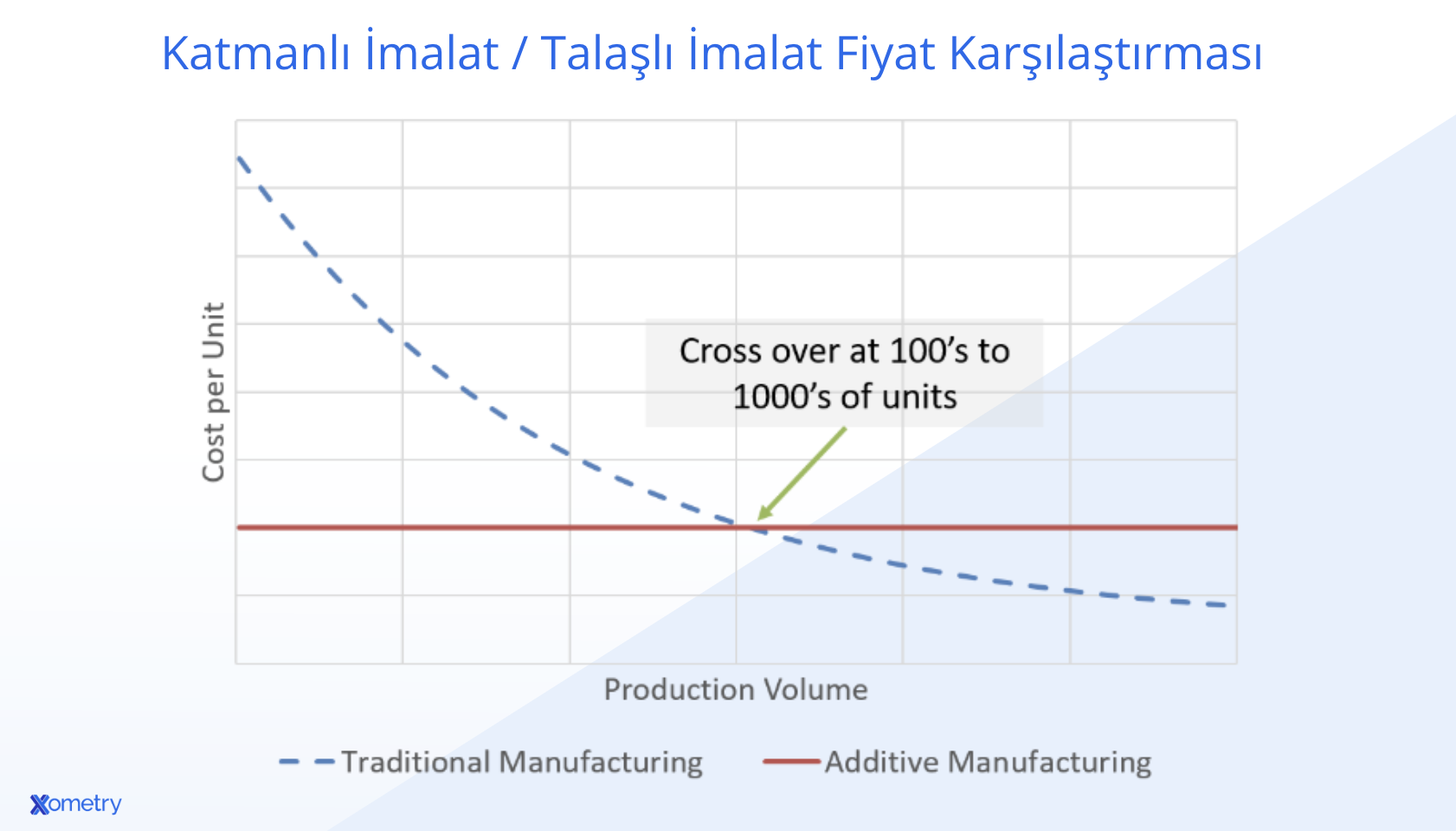
  • In layered manufacturing, it's a bit different. Generally, the unit cost is lower, but when producing parts of low to medium quantity, factors such as setup time and material costs come into play and can make it more expensive than plastic injection. If we look at the graph on the right, we can clearly see this. Traditional vs. Additive Manufacturing However, remember that this graph only shows the change in unit cost depending on the quantity. If you notice, the intersection point is somewhere between 100-1000 units. At Xometry, we can recommend the most suitable production method for you according to the part design, delivery time, material properties, and project requirements. Important Notes:

  • Plastic injection molding is generally more economical for high quantity and relatively simple parts.
  • If you have low quantity or more complex design parts, if you need quick prototypes or if you need to make design changes frequently, layered manufacturing may be a better choice for you.
  • Xometry offers services such as project support and DfM (Design for Manufacture) analysis to help you optimize your design for both traditional and layered manufacturing. For more information, you can contact us at info@xometry.com.tr.

In Conclusion: The best price/unit balance does not depend solely on the number of units produced. Xometry, with its expertise in both fields, guides you and helps you choose the most effective solution for your project.

    • e
      After how many productions does the price difference between layered manufacturing and plastic injection optimize?
      Automatically translated from: Türkçe

      See original
      0
    • Hello,

      As you would appreciate, this is not simply a “after so many units” answer. In fact, we need to look at a number of factors such as part geometry, required delivery time, and material to be used to choose the most cost-effective production method.

      • In plastic injection, the mold cost decreases as it is divided by the number of parts produced. So, the more you produce, the more advantageous it will become.
      • In layered manufacturing, it’s a bit different. Generally, the unit cost is lower, but when producing parts of low to medium quantity, factors such as setup time and material costs come into play and can make it more expensive than plastic injection. If we look at the graph on the right, we can clearly see this. Traditional vs. Additive Manufacturing However, remember that this graph only shows the change in unit cost depending on the quantity. If you notice, the intersection point is somewhere between 100-1000 units. At Xometry, we can recommend the most suitable production method for you according to the part design, delivery time, material properties, and project requirements. Important Notes:
      • Plastic injection molding is generally more economical for high quantity and relatively simple parts.
      • If you have low quantity or more complex design parts, if you need quick prototypes or if you need to make design changes frequently, layered manufacturing may be a better choice for you.
      • Xometry offers services such as project support and DfM (Design for Manufacture) analysis to help you optimize your design for both traditional and layered manufacturing. For more information, you can contact us at info@xometry.com.tr.

      In Conclusion: The best price/unit balance does not depend solely on the number of units produced. Xometry, with its expertise in both fields, guides you and helps you choose the most effective solution for your project.

      0
      Reply
Layered manufacturing plastic injection price performance
Your information:


Cancel

Suggested Topics

Topic
Replies
Views
Activity
Feasibility of using DMLS aluminum parts for pressure-test prototypes
I’m testing the idea of using DMLS Aluminum parts as pre-production prototypes for a high-pressure fluid system. These would be static housings only, not moving parts. Has anyone validated 3D-printed aluminum components under realistic... read more
A
0
103
Nov 24
Process for a low-volume stainless steel pump impeller
Hi all, I’m designing a stainless steel impeller for a small pump (diameter around 80 mm). Would you go for metal additive manufacturing or casting if you need tight tolerances on the blades and... read more
p
c
1
196
Nov 24
Minimum letter size for raised text on SLS nylon parts
I’m working on a medical device enclosure that needs raised lettering (product name and serial number) on the lid, printed in SLS nylon. The letters are around 2 mm high with a stroke width... read more
m
j
4
514
Oct 30
2 mm stainless sheet bend radius
I’d like some help with a project. I’m designing a stainless steel 304 enclosure with multiple 90° flanges (sheet thickness ~2 mm). For strength and edge alignment, I want the inside bend radius to... read more
L
C
4
404
Oct 24
Urethane casting for sensor housings
Hello all, I’m looking for some advice. I’m working on a prototype of a handheld casing for an outdoor sensor (approx. 20×10×5 cm) that needs to be rigid, weather-resistant, and have fine surface details.... read more
a
e
6
208
Nov 13