

 Europe
  Türkiye
  United Kingdom
  Global





 Login with my Xometry account




The CEO and co-founder of Neuramill, Nistha Mitra, told us why CNC programming is still a bottleneck, what it means to capture tribal knowledge in software, and how her team is building a co-pilot for machinists.
CNC Programming as a Free-Body Physics Problem
What is the problem with CNC programming today?
I see CNC programming as a free-body physics problem that needs a lot of detailed expertise on 3D modelling, material science and everything revolving around machining. Unfortunately, all of this knowledge is in someone’s head and it’s very hard to teach it to someone else. It takes about ten years for a junior CNC programmer to really wrap their head around this process.
And there is no structured way to capture that tribal knowledge and make it repeatable. A senior machinist walks out the door and they take all that knowledge with them.
Can you expand on that a bit?
Over time, a machinist learns how to analyse the CAD file, the step file, the GD&T they’re getting from design. Based on that, they can say whether something is machineable or not and figure out what combination of material, machine and tools will produce the part to specs.
Within that, there are so many nuances. Hundreds of types of tools, different coatings, different numbers of flutes, lengths, diameters. Which tool works for which operation? If your tolerance is high versus low, your operation sequence changes. In your simulator the material removal is perfect, but in real life, if you remove material from near the centre of mass too fast, the entire part can warp.
A junior machinist won’t know that. A senior machinist has experienced those issues first-hand and that’s why they know not to take out the big cavity right away.
And the worst part is nobody’s recording those mistakes. I cannot learn from your mistakes and you cannot learn from mine. We are all making the same mistakes over and over. The solution is an intelligence layer capturing these decisions so we can retain the accumulated knowledge.
Why can’t existing CAM systems solve this? They’ve had feature recognition.
First of all, feature recognition is actually not the best when it comes to complex parts. We’ve spent a lot of time building our internal CAD classifier and we just did a benchmark where we’re beating most of our competitors for complex five-axis parts.
Second, CAM software does exactly what it promises – it does CAM. It says “make all the decisions and then input those decisions.” It never sits with the machinist as they’re making those decisions. You cannot analyse a CAD file in CAM the way you can with a pre-CAM software.
There are no physics checks in the system. For example, if you’re using a tool with AlTiN coating on an aluminum part, it’s going to create a weld. CAM will never warn you about that. A machinist is doing that check in their head. That’s what we’re bringing to the table.
The Intelligence Layer Between CAD and CAM
So what does Neuramill do?
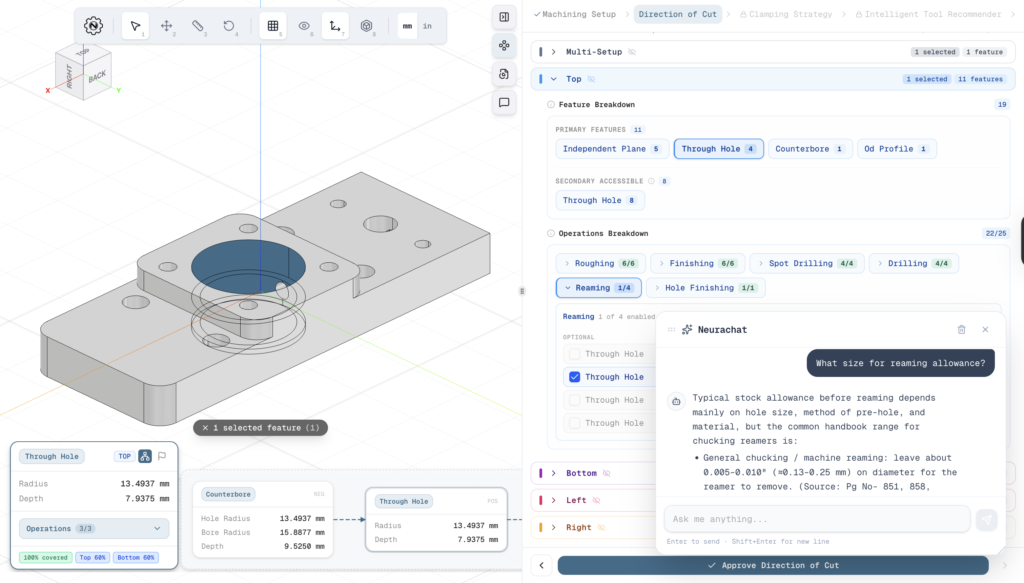
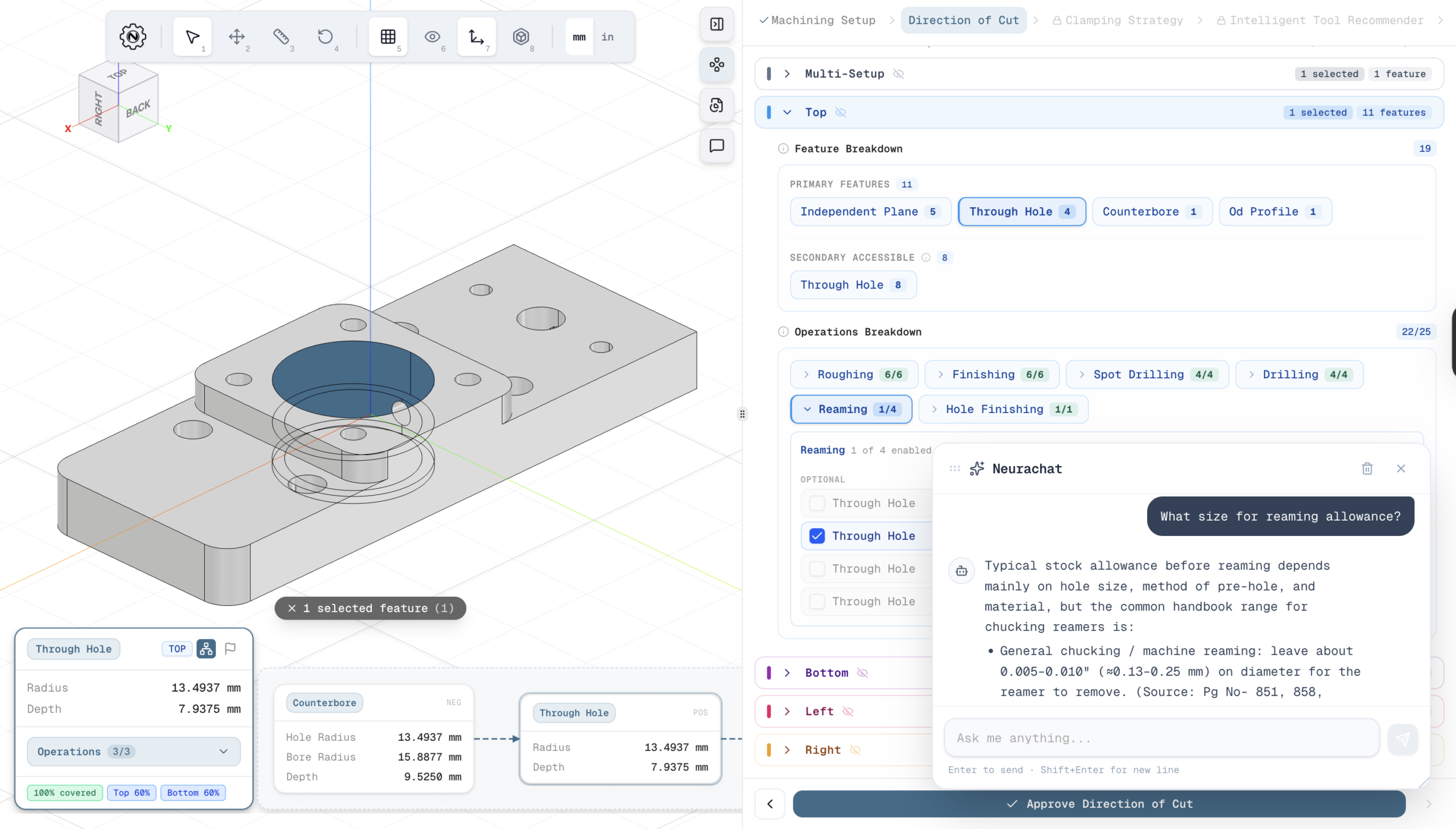
We are the intelligence layer between engineering intent and manufacturable decisions. All the steps between receiving the design and entering the NC code, we sit right in between. Our software interprets the geometry as physical features and manufacturing intent, maps those to valid operations, tools and setups, and then reasons under constraints like tolerance, material behaviour and tool access to produce a structured manufacturing plan.
Neuramill analyses a complex part within a few minutes, whereas it would otherwise take twenty hours. Everything is based on your preferences. You can set your own policies that are repeatable across every job. And once you’re ready, we help you automate the CAM as well. We do have a plugin for CAM but we also sit separately as a standalone solution.
The idea is to build a co-pilot for the machinist, not just do CAM or pre-CAM. Our future products are bridging the gap directly from CAD all the way to the machine.
What is the actual output?
Our current product outputs a structured manufacturing plan: an operation sequence based on your clamping strategy, which tool to use from your library for each operation, how much time each tool takes, and reasoning-based speed and feed recommendations. Every decision is traceable. The system also shows confidence scores based on similar past parts, so your machinists can see how well-supported each recommendation is. All of that plugs into your CAM.
We’re also working on a configurator that semi-automates the toolpath based on the toolpath behaviour you want, so you don’t have to keep clicking multiple faces and selecting strategies manually.
In the process, we’re also giving you a tribal knowledge dashboard. Say a machinist edited speed and feed for a part, and the next part is very similar. If they’ve done it five times in a row, the sixth time we prompt them “you’ve reduced speed and feed from baseline for the past five similar parts, you should do it again.” That’s tribal knowledge being recorded and made available on every future job.
What constitutes a similar part as there can be a lot of variance from small details?
There are some fundamentals, obviously. You could have an identical part, but if it’s titanium alloy versus aluminium, that completely changes the parameters. Then there are features like open pockets with holes inside, nested holes with counterbores, complex geometries.
We’ve talked to our customers and figured out the list of things they’re actually thinking about when they say “this is a similar part.” A lot of the time, these amazing CNC programmers say “I know, I just know.” And I say “please tell me how you know.” It’s taken time but we’ve managed to codify what goes on in a CNC programmer’s brain.
How do you get GD&T information into the system?
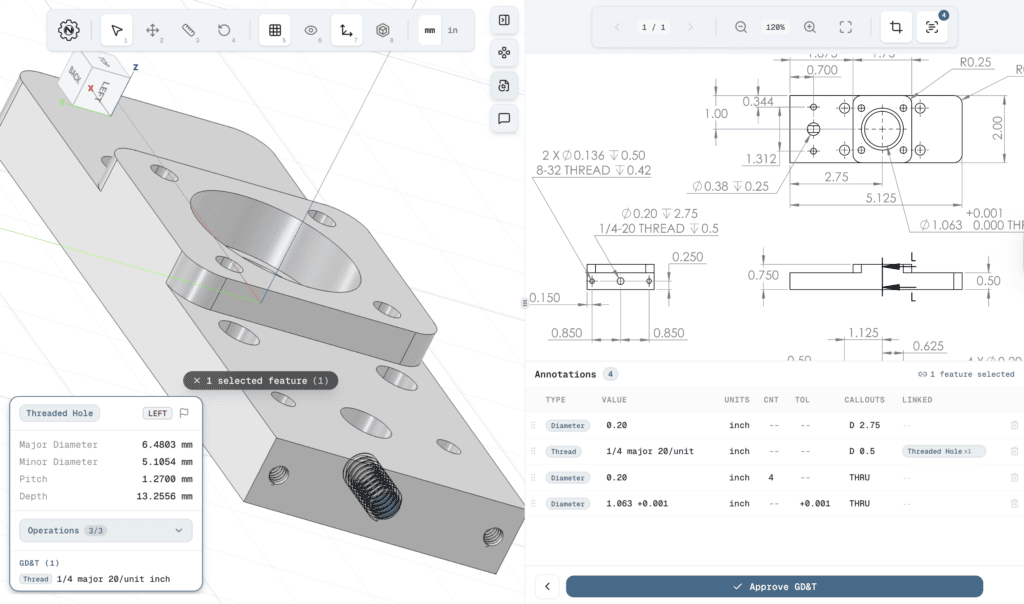
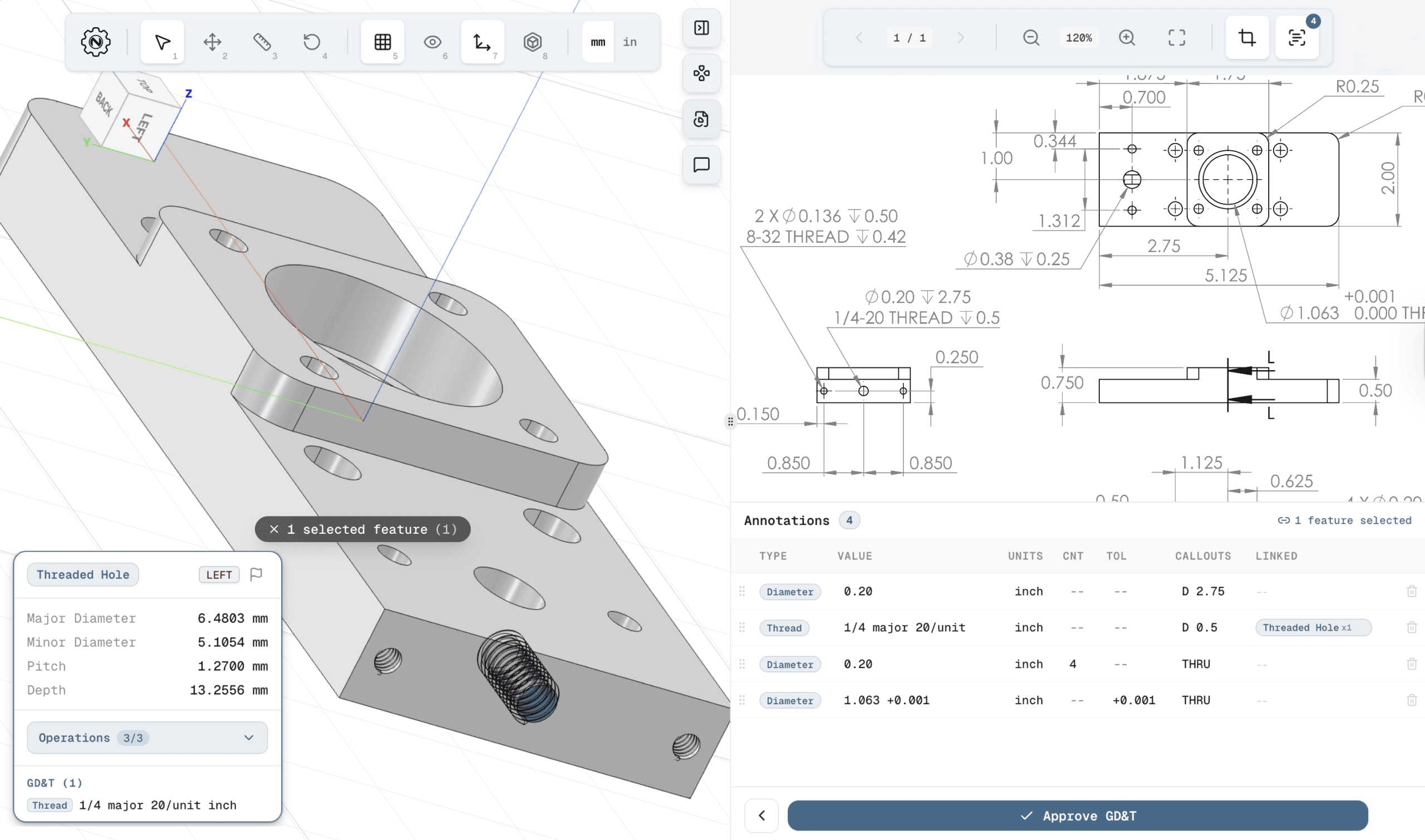
We have a vision model that extracts the different control frames and annotations from drawings. You can connect those to the features you care about. Sometimes in a STEP file they don’t even write the threads. They only have a hole, but the drawing says it’s threaded. You just connect that annotation to the hole in our software and we take it downstream.
What role does the machinist still play?
I think there’s a lot of misconception about what AI will do to this industry. Being a CNC programmer is so complex, there are so many nuances, no AI can replace that. Our machinists review and approve every plan we generate. Every output is transparent and editable, not a black box.
There is a machinist shortage. Our software gives you a co-pilot so you can 10x your output. I see our software as the Iron Man suit that just lets these same experts do a lot more when fully equipped.
Focusing on Aerospace
Who is using Neuramill today?
We’ve started with smaller shops, ten to twenty million in revenue. We’re also onboarding a mid-cap enterprise, a space company.
What type of clients gets the most value?
Right now, high-mix work is benefiting the most because that requires a lot of unique setups. The volumes are secondary.
So we’re mostly focusing on aerospace and space right now. They have these complex 3+2 and five-axis parts that they have to program again and again.
What gets people in the door?
Smaller shops want toolpath automation. They’re in such a rush, they want a digital twin that creates toolpaths the way they do. Bigger companies care about that too, but they also care about the standardisation we provide.
They felt a huge pain during 2020 when so much of their workforce retired. They care about tribal knowledge collection, about setting policy for the entire shop so that twenty different people aren’t using twenty different strategies, making it hard to trace what went wrong.
Anything customers found more valuable than what they first signed up for?
A lot of them come in thinking we’re doing what CloudNC is doing. Then they see our software’s flow, which mirrors how a CNC machinist actually thinks about making a part – analysing it, connecting the GD&T, figuring out the material, the machine, the clamping strategy, and then the operations.
When they see that laid out as a standardised process, they realise their ten young programmers can trace the logic without having to ask the senior guy every time. They come for the toolpath. They stay for the entirety of pre-CAM to toolpath.
What CAM systems do you integrate with?
Currently we support Fusion, Mastercam, and NX is in production. We also have something in store that might make us agnostic of whichever CAM software you have.
Deployment in Days
What’s the pricing structure?
We do per-machine pricing and match the pricing with the business needs, so the final numbers will differ but we can talk about a range of $200 to $1000 per seat for a monthly subscription.
How long does deployment take?
I’d estimate anywhere from one to two days of onboarding to two weeks, depending on how messy the data is. And we almost do it for them.
We use a forward deployment engineering method. We’ve seen that shops struggle to get their data into the system and spend weeks on it. So we go to the shop, figure out how the data is stored. Some shops don’t have any structured data at all.
Bigger shops might have a vending machine or their own tool dataset. Smaller shops might just have a bunch of invoices. So we go and onboard your tools for you using a set of internal tools that lets us scrape, standardise and normalise the data and add it to your profile in a matter of days.
Where does the data live?
We’re cloud right now. But we’re also in conversation with some DoD organisations and we’re supporting on-prem. Within on-prem, there are different flavours. Some have their internal AWS systems, some literally have their own servers. We package it to work on both.
The Growth of the Intelligence Layer
This space looks quite competitive already.
I would honestly hope more competition comes in, especially from the younger generation. When you haven’t been in an industry too long, you don’t have a set way of doing things, and that’s where the unhinged solutions come from.
There’s a massive machinist shortage and reshoring is accelerating. How much does that drive demand for what you’re building?
We see it on a macro level as everyone’s talking about it, investors know about it, big manufacturing companies are raising exorbitant amounts of money to support reshoring.
And then we see it on a micro level in the form of the stress that a CNC programmer is going through because they have to produce parts to survive, but they only have 24 hours in a day. We’ve seen younger programmers stressed because they want to help but they don’t want to break a part, because that’s hundreds of dollars wasted. That’s kind of why we started this.
Will AI get to fully automating CNC programming?
If someone is saying AI will do everything from start to finish and they actually know what AI is, they’re just doing it for marketing. I cannot believe any actual AI scientist saying that. Being a CNC programmer is so complex, so many nuances, no AI can replace that. We will always need experts. We just want them to be 10x.
What does the future look like for Neuramill?
We’ll focus on CAM until the end of 2027. But we’re not doing things sequentially. I’ve hired machine learning interns and started R&D on reinforcement learning and simulation. Adding sensors to machines, getting the vibrations, understanding how heat in the internals changes based on the tools and toolpath you’re using. We’re researching that now so we can start thinking about deployment around 2028.
Any interesting AI companies in manufacturing you’d highlight?
I love Uptool. They figured out a broad horizontal pain point and have done a phenomenal job in providing an excellent user experience.
Related Topics
 Uliana Krayneva
 1
2
1
2



Comment(0)