

 Europe
  Türkiye
  United Kingdom
  Global








 Login with my Xometry account




We sat down with David Priev, co-founder and CEO of Limitless Labs, to talk about why CAM programming is still a bottleneck, what an agent can and cannot do today, and what happens to the trade when the people who know how to cut Inconel retire.
Closing the Skilled Labor Gap
What problem are you solving?
The productivity gap with CNC machinists and manufacturing engineers who deal with CAM programming, and with engineering tasks related to CNC manufacturing in general.
Why this problem, and why you?
I spent a lot of my career right at the intersection between design and manufacturing, including production sites. On the one hand I saw how fascinating the technology is. On the other hand, a lot of young folks are not interested in going into the trades, and everyone from a small machine shop up to huge corporations struggle to find, train and keep the people who turn a design into a physical part.
The second reason is that the West is trying to reclaim manufacturing. Precision manufacturing is the backbone of aerospace, defense, medical devices and semiconductors, and the States neglected that industrial base for 20 or 30 years. The only way to close the skilled labor gap, in my opinion, is technology. That is where me and my co-founders, who both come from the AI research world, saw the potential of physical AI that can understand CAD and the physics of cutting metal.
What is the biggest time waster in a CNC programmer’s day?
Repetitive work. Chamfers, deburring, drilling. Straightforward jobs, but they still take a lot of clicks and a lot of parameters, because CAM softwares are not advanced at understanding geometry, physical limits and tolerancing. So the human spends hours, sometimes days, on work that is simple to solve.
The second thing is that getting the geometry with a cutting tool is almost always achievable. The question is how long it takes on the machine and whether you hit the tolerances. Materials deform, tools wear differently, so it comes down to your creativity. How to fix the part, which tool, which cutting pattern. You sell machine time, so you have to be efficient, but you also don’t want to break a tool or scrap parts. That is the beauty of this problem. It is a very complicated and sophisticated optimization problem.
You have written that when your best programmer retires, 25 years of expertise walks out the door with him. Doesn’t that just make a case for better documentation?
In a perfect world, yes. But even at the most sophisticated sites there is a lot of tribal knowledge, because you are measured on getting parts out, not on documenting. And even if it were all written down, how do you document cutting conditions for different geometries, materials, machines and scenarios? It takes a lot of visualization. So most of that knowledge sits in the minds of the experts who are about to retire.
At the same time, those experts generated a lot of data, because they programmed a lot of parts. G-code, CAM projects, setups, all sitting somewhere in a PLM or a folder on a server. Manufacturers have a lot of data and it is like a gold mine. There has just not been an efficient way to use it.
So you can capture that know-how from historic context?
One of the unique things we developed is not only the first agent that can automate CAM, but one that learns from historical data, using CAM projects as the source. You don’t need to do anything for it to digest that data.
It is a hard problem because a CAD/CAM project is a messy project tree of different objects in different formats. So you get a customized agent that captures your organizational know-how and treats parts the way you want them treated, rather than with out-of-the-box reasoning.
Automated Machining Plan You Review
Let’s get to the product then. Walk me through CAM Agent with an example part, say a steel hub. What do I actually do?
The agent is LLM-based and it integrates into your local CAD/CAM session through a driver you install, which talks to your CAM software and to our cloud. You open your CAM, pick the stock geometry, load your tool templates. Nothing to do with our agent yet.
Once the setup is defined you open our agent window and it connects to the session live. Then you tell it, “I have this DMG machine, these are my tools, this is the CAD, these are the tolerances.” And you can get more specific than that, telling it to “Avoid those areas. Don’t do this type of roughing, I prefer this strategy. Don’t drill those holes.” All of it in natural language.
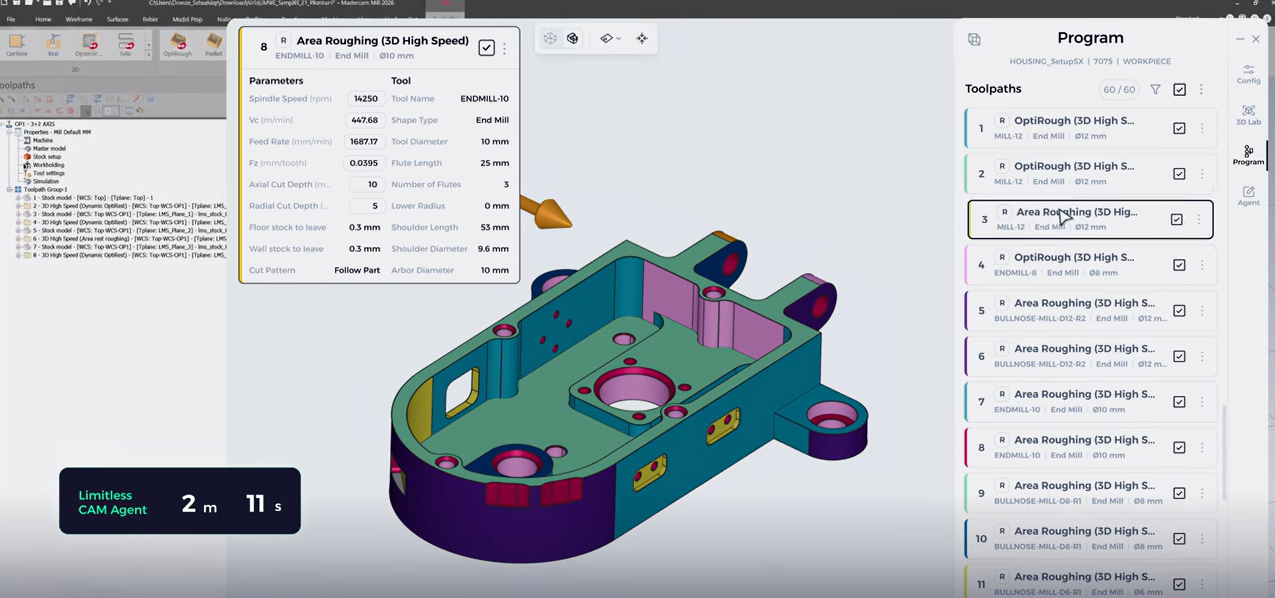
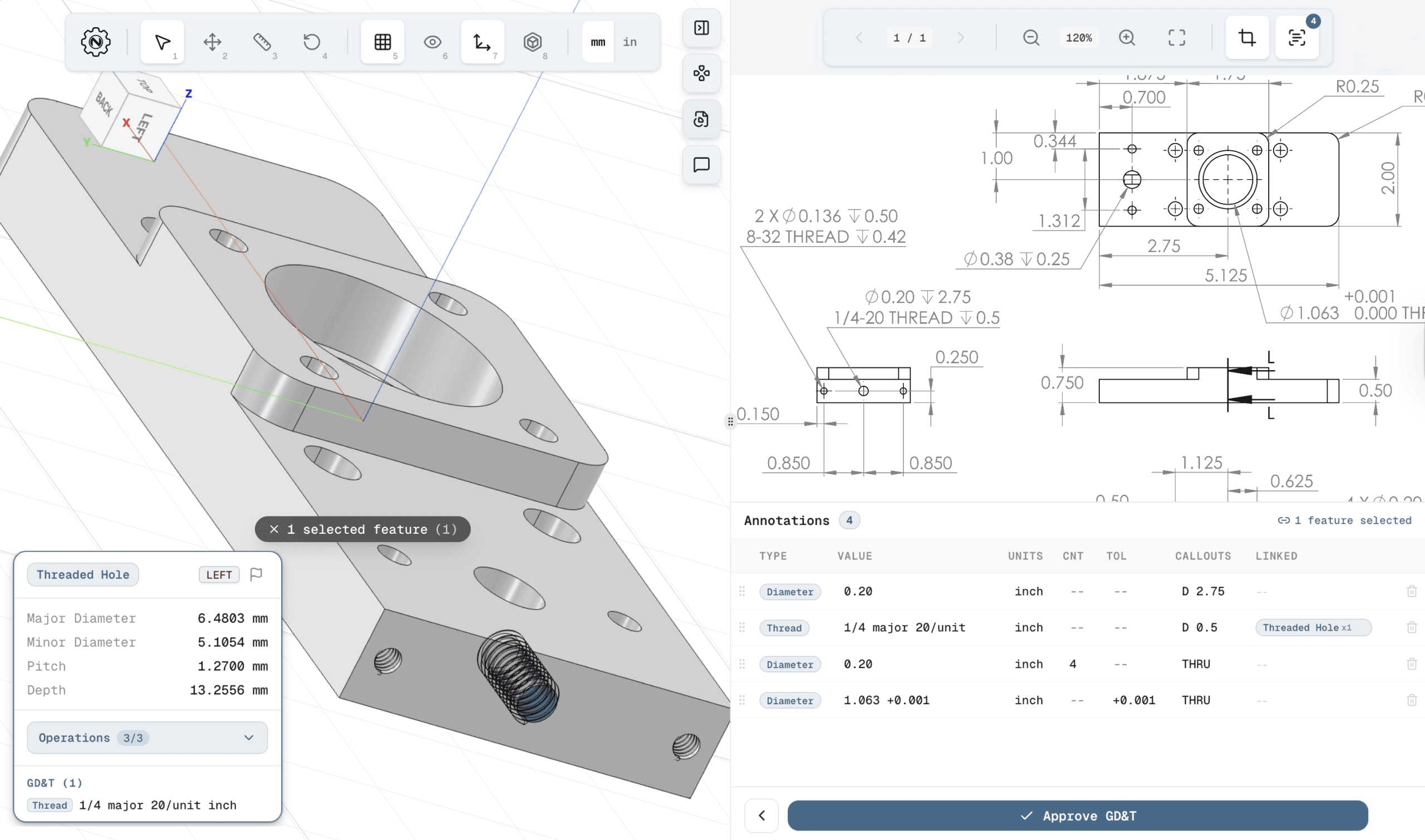
Then the agent shows you a plan. We have our own CAD interface where you can review the whole plan before anything is generated. Once you are happy you tell it to execute and it builds the toolpaths right inside your CAM environment, as regular toolpaths you can edit as if you had done them yourself. Instead of hours or days, you are done in 30 minutes, maybe an hour, together with the agent.
And how long does the agent itself take to think?
Between 30 seconds and five minutes for a very complicated part. Though complicated does not mean solved perfectly. It processes the whole thing and suggests how to machine every area, but it will make mistakes. Complex parts are not complex throughout, so some areas still come out with great accuracy.
We just had a post on LinkedIn about a crazy part from one of our prospects, a mold with 500 different toolpaths. Something that takes weeks to program, and the agent got through it in five minutes. Maybe 30 percent of the recommendations were very good and could save three or four days, but 70 percent were not what an experienced mold maker would do. On mid-level parts that take two or three days, it does 80 percent of the job really well.
Can I ask why it chose a particular strategy?
Yes, and it will give you a logical answer that is not LLM hallucination, because it uses the physical engine we developed. We take into consideration tool collision, tool performance, the capacity of the spindle, the different phenomena in the process that lead to that strategy.
You say the agent is rooted in real-world physics. What does that actually mean?
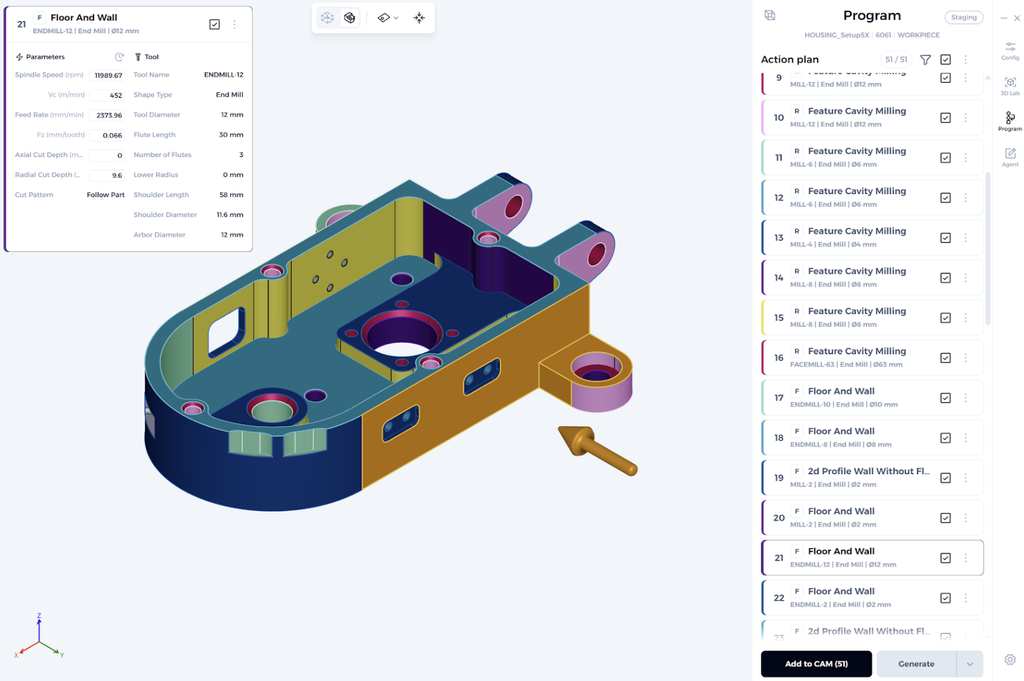
It means we invested a lot of time in a physical engine that estimates the phenomena happening between the cutting tool and the material. Tool deformation, deformation of the workpiece, tool wear, vibration, heat. All the things an experienced machinist takes into account intuitively. Building that engine, validating it on real cases and fine-tuning it, that is one of our unique IPs.
You can call it a world model, one that describes the world of cutting metal for different machine kinematics, materials and tools. It lets us make decisions from physics and not just from seeing the geometry. Show me the same geometry in Inconel and in aluminum and you get two completely different plans.
I can imagine spotting the mistakes in that 30 percent being harder than programming the part from scratch. What’s the actual impact?
About a week ago one of the senior programmers at a tier 1 aerospace company gave the agent a part that had been programmed 40 percent manually, to see how it would handle the rest. That is another capability we have, by the way. We can pick up at any step. It is not a black box you have to work with from the beginning. The agent programmed the remaining 60 percent, he reviewed it, ran the machine and everything went perfectly.
The surprising part was that the job was Inconel. It is a super alloy that usually takes a lot of experience, because you can easily kill your tools, even break them immediately, if you approach it with the wrong cutting condition. Because the agent understands the physics of different metals, it got it pretty right, and we were blown away, because we had never run an Inconel part with our users before. It shows how this technology can sometimes perform like a machinist with five or ten years of experience.
Beyond that, we all use Claude and ChatGPT daily, and after a while you have a good intuition for what they will nail and what you need to watch. It is the same here. Our users know where the agent shines and where it has an idea you should ignore. So on complex parts, if you know where it is good, you are going to trust that 30 percent most of the time.
And on the geometry side, you have opted for something else than feature recognition. What are you doing instead?
We were there too at the beginning, thinking we should look for patterns, like features. But simple parts can be described as features, while real parts are usually more complex and have no features in them. It is just topology. You have intersecting things all over the place and you cannot describe them as features. It breaks immediately. So we came up with a different technology. It doesn’t hand you named features, but our AI understands pretty well what type of cutting operation to apply to each geometry. It is not pattern matching, it is more like spatial reasoning.
Enterprises and OEMs as the Main Users
What does your best-fit customer look like, broadly speaking?
Mainly enterprises, for two reasons. One, the agent can be customized. Each site has its own know-how, its own machines, its own tools, and the customized agent holds on to that organizational knowledge, which also means a new machinist can just ask it how things are done here.
Two, we put a lot of effort into infrastructure, privacy and security. We are ITAR compliant, deployed in GovCloud and now going for FedRAMP. So the ideal customer is an enterprise with in-house production CNC sites, usually 1,000 employees and above. Lately we are also exploring OEMs with 50 to 1,000 employees. We haven’t figured out the right go-to-market for shops under 50 yet.
You said every site has its own know-how. Wouldn’t a large organization rather use you the other way around, to level all its sites up to one standard?
That is true, but up to a certain point. They don’t want to buy different tools all over the place, so they standardize into a smaller group and get a better price. But different sites order the same material from different vendors, because geographically they may be far apart. That same material grade may still have slightly varied properties. So sites develop their own tweaks around cutting conditions that work for them and won’t work elsewhere. Those are the things you want to keep local. And OEMs often build sites around specific product lines. One site does hydraulic valves, another does pneumatic valves, and the machining has different nuances.
Your website lists huge enterprises as customers. How does a company that raised its Series A six months ago land customers like that?
A combination of two things. One is that this is what we focus on, whether that means a customized solution or meeting their IT and cyber requirements. That is something you have to commit to as a startup, because it takes a lot of effort, and a lot of solutions in this domain do not meet those standards. Secondly, it is a need on their side. They are actively looking for AI that helps with how hard it is to recruit and keep people, and with raising capacity, because capacity is not only dependent on machines. It depends on knowledge and skills.
A Single Day of Training for Launch
How long from signing up to actually using it?
One day of training. The experience is like installing Claude or ChatGPT on your computer. You download it and you start working. That is the out-of-the-box agent.
Customization is trickier and takes effort on both sides, but we want to get to a point where users customize on the fly, the way you build skills in Claude today.
It is an add-on to an existing CAM. Which CAMs can I use it with?
We are integrated into Siemens NX and we support Mastercam, which is the largest CAM vendor, especially in the States. We are working on Creo by PTC, and there are several more on the roadmap that I cannot disclose yet.
Your model gets better the more data it has. How can a company be sure its data won’t end up benefiting a competitor?
We sign on it in the contract. We are not using our enterprise customers’ data. There is a specific feature for it in the product. Do you want your data to be yours? Then we won’t learn from it, and even if we stop working together, everything in the agent version deployed for you is yours only. Or you can decide you are fine with Limitless using it to improve the product. And even then we use it anonymously. It has no connection to your clients, we don’t even touch drawings, we only use the CAD model and the toolpaths you generated.
You Won’t Need to Be an Expert But Experience Still Matters
You have written that this is the programmer function running at machine speed. Are we close to AI replacing CNC programmers?
I think we won’t see programmers replaced by AI soon. We will see the same landscape we see today with coding agents. People with no coding background are building pretty cool simple projects, and that is what you will see with machinists. A fresh machinist with AI will handle parts he never saw before.
The second thing is that experienced programmers become ten times more productive. The skeptical people not willing to adopt new ways will find themselves out of the game. Not because AI replaced them. Because the machinists who adopt AI are going to be a lot more attractive to hire. I don’t think anyone would accept a software developer who tells you in the interview that he never uses AI.
How far are we from a regular person buying a 20,000 dollar CNC machine and making parts at home, the way 3D printing got democratized?
At a hobby level, with friendly materials like wood, aluminum and brass and no tight tolerances, you are going to be fine. If you don’t care about the time, you are going to get the shape. But at industrial grade the materials are not changing. They are still hard to cut and it is a competitive landscape, so the expertise will remain. It will be much more approachable with solutions like ours. You won’t need to be an expert, but you still need to be a good reviewer, and to judge things right you need a bit of experience.
What will CAM look like in five years? The models are getting better so fast. What is left of the interface?
Generating CAD models will be completely dominated by AI. CAD softwares will be there mainly to retrieve historical data, and as time goes by they become more of a backend thing and less of the user-facing experience. CAM is where it gets interesting. The reason we are getting a very good pull from the market is that there are not many solutions doing AI for CNC and CAM. It is not about drawing sketches from a prompt. It is understanding where you have tool access, what the right cutting tools and conditions are, how to tweak hundreds of parameters in toolpath generation. So unless a new ModuleWorks appears doing all the toolpath algorithms with pure AI, and I don’t believe we will see that, CAM softwares stay where they are today.
But solutions like ours become the orchestration layer, running the CAM behind the scenes. Sometimes you go in there to tweak something the agent interface doesn’t expose. But basically you have an agent programming several parts simultaneously, even on several CAM licenses. A lot of enterprises have a license server, so why not give the agent five licenses, have it run five tasks at once, and call the user when there is an issue. Then one user is doing the job of five.
There is a lot of competition in this space already. What will determine the winner?
First of all, I don’t think there is too much competition. A lot of tech entrepreneurs are not even aware of how things are made. Everyone is aware of 3D printing. Most of them are not even aware of subtractive manufacturing. And it is a tough challenge, not only on the technology side. Selling software to a manufacturing organization is hard, even if it is AI.
The winner will be determined by a solution that drives real value. This industry is tired of hearing promises about automation. That is the holy grail here, everyone is waiting for the magical automation to appear one day. When they see something real, adoption is really good. So companies focused on toolpaths that the users are happy with are going to win.
That is the beauty of manufacturing in my perspective. The pain is equal to dollars. If you save time, you save money, and it is immediate. It is not like R&D, where it is hard to measure whether a new AI tool is valuable.
Where does Limitless Labs go beyond CAM?
Right now we are an AI tool for CAM programming, but what we are building is the infrastructure to become the first, and hopefully the best, mechanical manufacturing engineer in the shape of AI. Next is the full process. How to machine a part, what the setups are, what stations it runs through. And then you can start doing quoting, because the most critical part of quoting is knowing the stages, the machining time and the cutting tools. If you have that, you have quoting.
Quoting in CNC sometimes seems close to random. The spread between two shops on the same part can be 100 percent. So this will be a thing of the past?
One thing I see a lot is that machine shops suffer from bad quotes. They quote a job, they even win the job, but because they quoted it poorly they lose money on it. That is something we can eliminate with this type of technology.
Any interesting AI companies in manufacturing you would highlight?
Hadrian are doing an amazing job, going all the way vertically, from the shop floor up to the orchestration and AI level. They are trying to develop not only a breakthrough in AI but the entire operating system rebuilt for manufacturers. New ERP, new MES, new quoting, new scheduling. That is bold.
Another one is Jeff Bezos’s new startup, Project Prometheus, which is still in the shadows and no one really knows what they are doing. It sounds like they are aiming aggressively at the world of engineering, mechanical and electrical, and manufacturing is going to be part of it for sure.
Anything you’d like to add that my questions did not address?
On a personal level, as a mechanical engineer back then when I just started, about 12 years ago, I really remember Xometry and this cool thing that could estimate your quotes and find new parts. I used it just to check whether my designs were quotable at least. Seeing this company grow to that scale is so cool. And I think the technology we are building can be an amazing multiplier for this type of business, because getting those quotes right requires you to understand how parts are made.
Related Topics
 2
2
 Uliana Krayneva
0
Uliana Krayneva
0



Comment(0)