

 Europe
 Türkiye
 United Kingdom
 Global


 Login with my Xometry account



Yaron Alfi, co-founder and CEO of Magenta, is a 20+ year aerospace engineer who spent half of his career in hardware and the other half in software, including around 9 years at SpaceX. He started out as a Build Reliability Engineer at SpaceX, then transitioned into building the internal systems that run the company. He told us why documentation was the thing he picked to fix, what it takes before a quality department will trust an agent, and why most of what his team has built is never seen by a user.
The Problem of Solving the Same Problems Over Again
What is the problem you are out to solve?
In regulated manufacturing, aerospace, automotive, anything with regulation, there is a side engineers do not really think about, which is how much documentation is required to purchase and build. As companies scale, it all increases. More purchase orders, more invoices, more work instructions, more nonconformances. So companies that set out to design cool things end up bogged down by paperwork.
We are solving that burden. Without an effective way to transfer, analyze and utilize all that data, a company grinds to a halt, and it is why so many struggle going from designing hardware to building it at scale.
So you have an issue, you solve it, you document it, and in principle you should be able to go back to that documentation and solve the same thing much faster next time. In practice the documentation is mostly there so you know who to point the finger at.
Exactly, and that is what you see a lot in manufacturing. Capturing information but not utilizing it. Imagine you are generating nonconformances across a bunch of SKUs. Parts are leaking, there are workmanship issues, you cannot get the bolt through. All of that data is there, but every time a problem occurs people treat it as a new problem rather than using the historical context. So it takes longer to resolve, because it relies on someone remembering, and the feedback loop that would stop it happening again is not there.
There is just too much to do, especially at fast-paced companies like SpaceX, or the startups that spawned out of it. Doing that job properly is a week-long research project. Dig up the information, analyze it, go and talk with people in different departments. Any time you want to properly utilize that knowledge, it becomes a project, so people do not do it.
You spent nine years at SpaceX, on hardware and on software. Of everything you saw broken, documentation is what you picked. Why?
When you decompose what an engineer does day to day, a lot of it is not engineering. It is writing things down. Taking two documents and making sure the pieces line up and make sense. Nobody likes doing it, and honestly documentation sounds boring, because it is. So the burden of it on engineers needs to be as minimal as possible.
You keep saying engineers. Whose job are you actually changing the most?
I talk about engineers all the time, but a lot of our solutions are not just focused on engineering. It might actually be supply chain, so, how you purchase hardware and make sure the paperwork is in order. In earlier companies there was no purchasing team and no quality engineers, so design engineers do all of it. As companies mature, they start building out supply chain, quality, and accounting teams. So it is for both engineers as well as other departments, because everyone has to do the same thing at some point in a company’s lifecycle.
Automating Documentation in Every Department
So what does Magenta do?
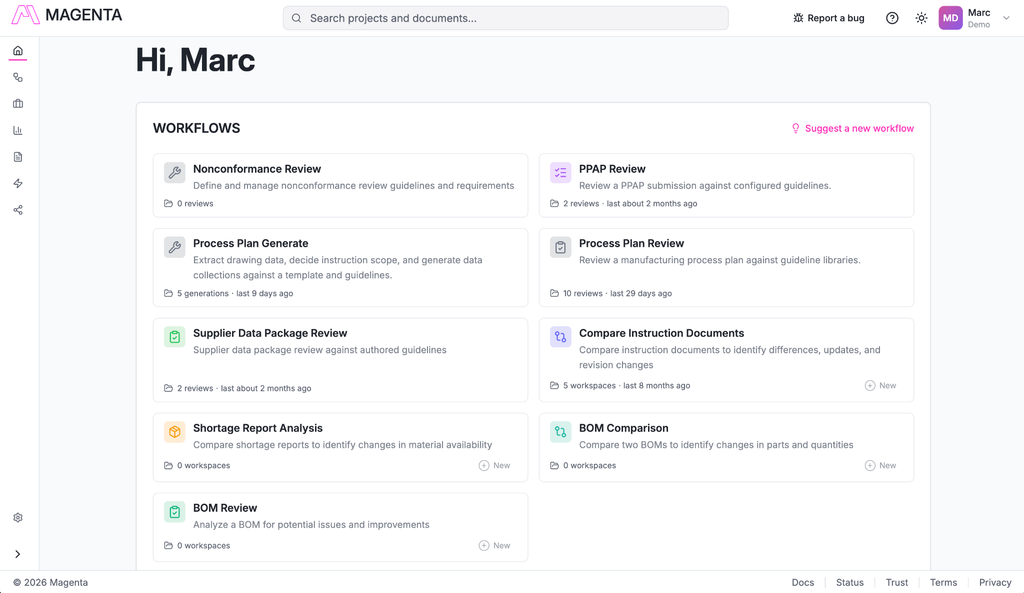
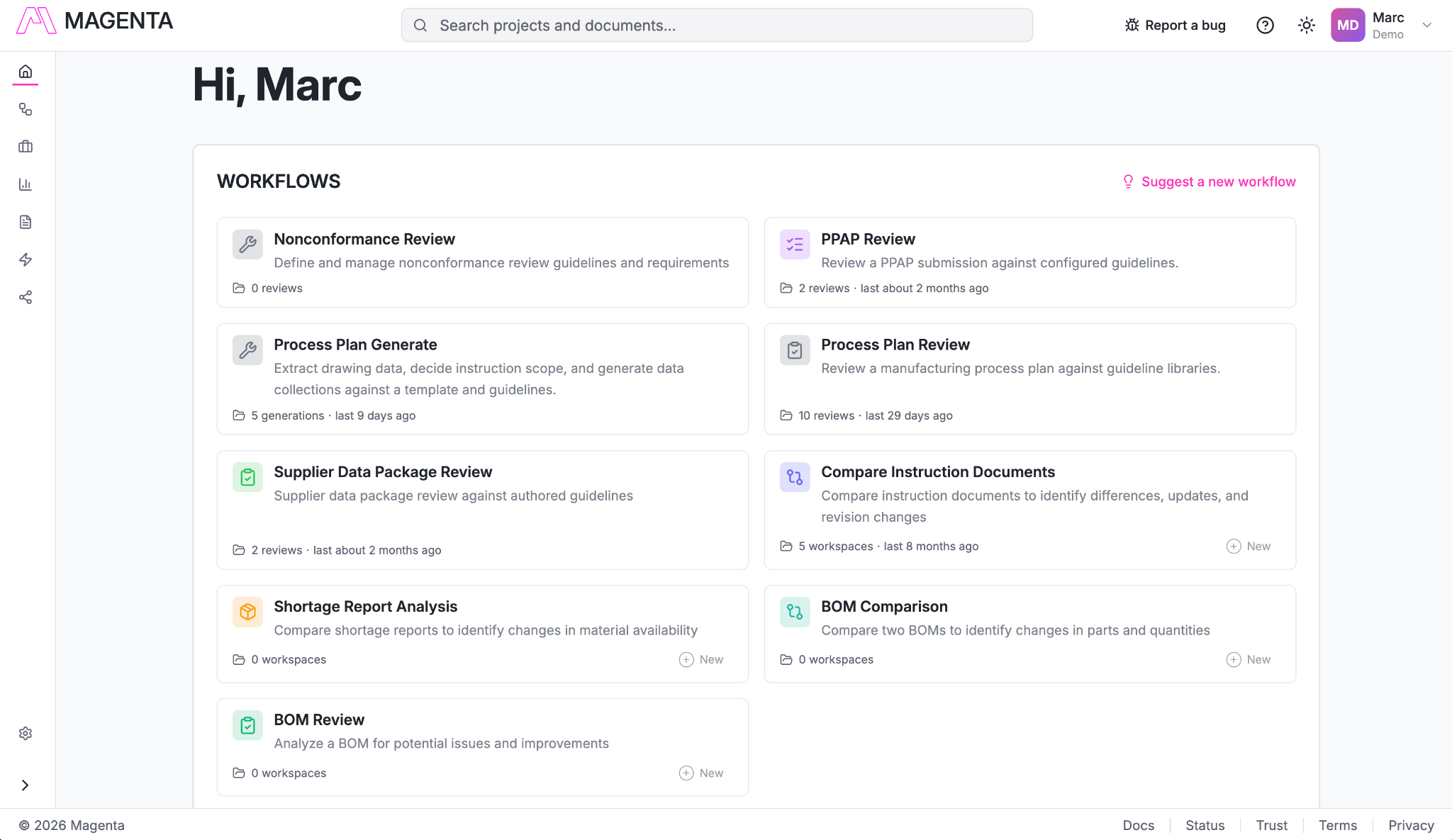
Magenta is a platform that uses AI agents to tackle complex, multi-departmental workflows. It sits on top of the solutions companies already use. Their ERP, their manufacturing execution system, their accounting systems, so it can use that context to do real work.
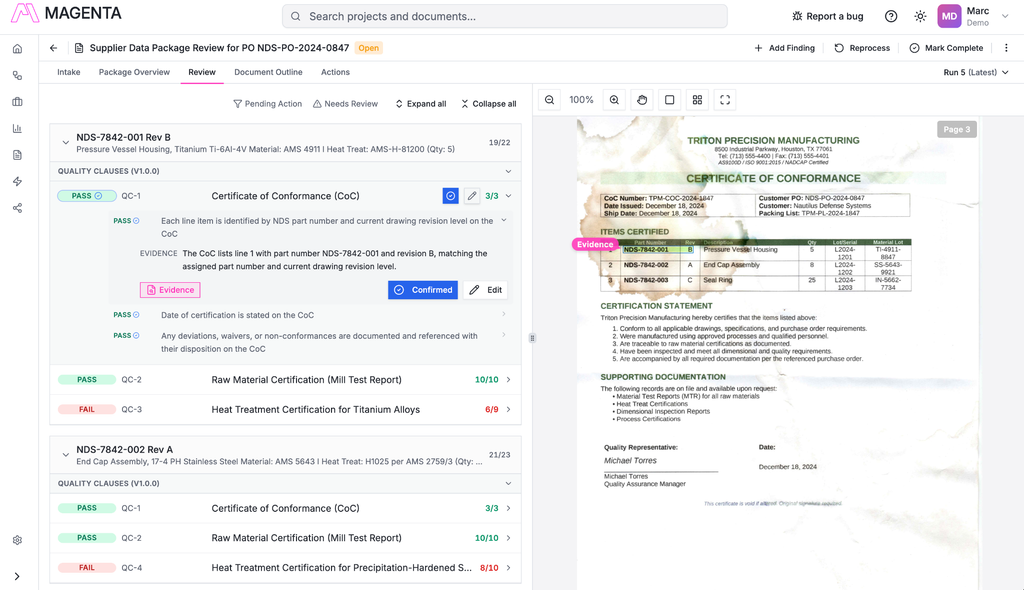
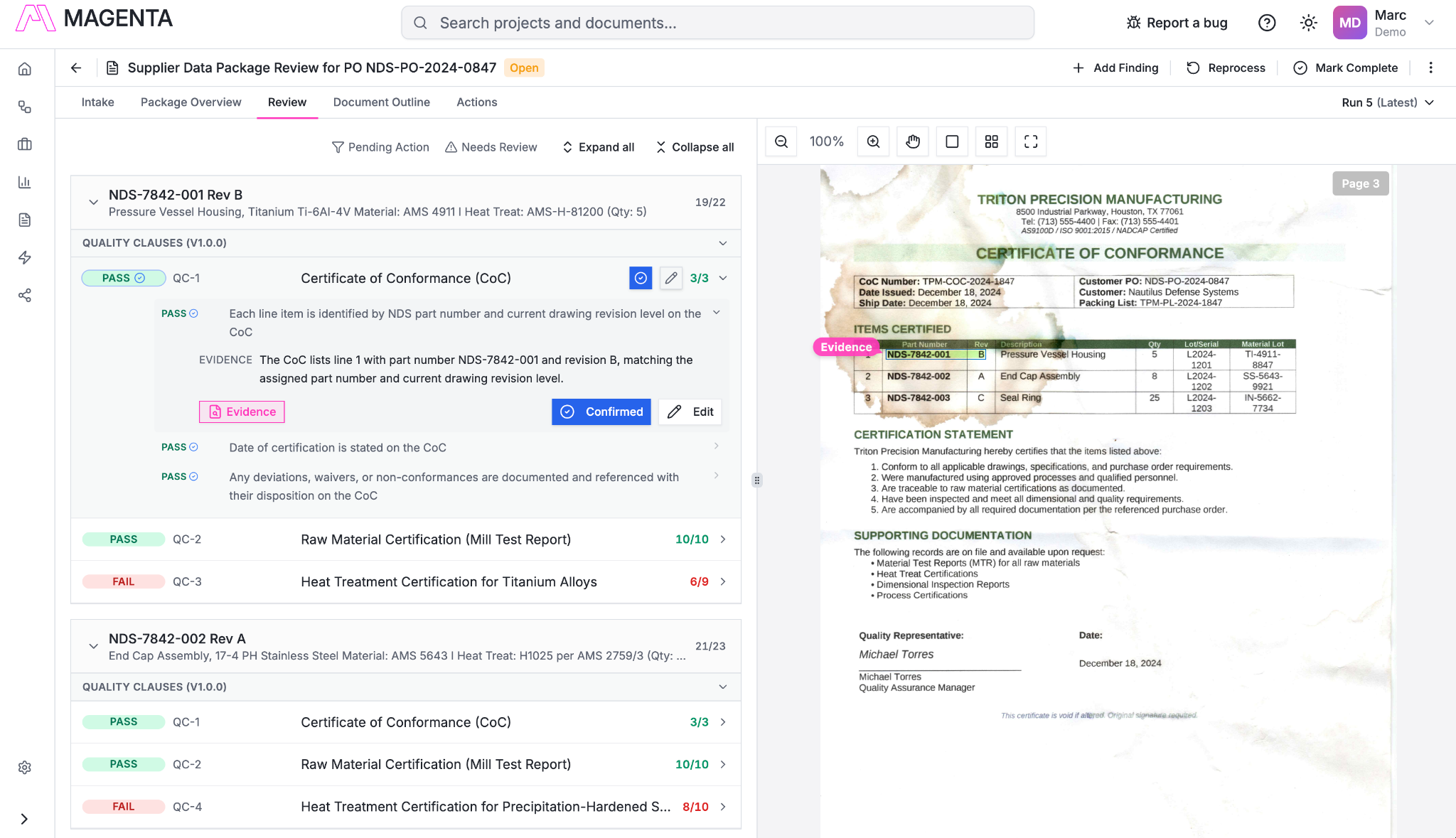
For example, in aerospace and other regulated industries, ordered parts have to come with documentation proving material traceability. Certificates of conformance, where the material came from, whether it met testing requirements. So when a part is received, the inspector is not only doing a dimensional inspection, they also have to read through what can be a fifty to a hundred page set of papers for each shipment. Our tool takes that, indexes it and runs it against a checklist that says whether it passes or fails. Then we work out how to move the process upstream, so the paperwork is validated before the parts arrive.
What else can the agents do?
We have workflows around validating invoices, so telling a company whether they are good to pay a bill. It checks general ledger codes and categorization and makes sure there is nothing odd with tax. In one case Magenta caught a supplier charging full tax on a partial shipment, which went completely undetected by the accounts payable team. We also take a drawing or a model and build work instructions off it, and validate instructions before they go to the shop floor.
Generally we like to identify three workflows, ones affecting different parts of the organization. Supply chain, manufacturing, and quality. Because the workflows can also talk to each other. If one agent is analyzing invoices from a supplier and another is analyzing data packages from that same supplier, we build a picture of how good the whole relationship is. A supplier that gives you good parts but sneaks extra charges onto invoices is not a good supplier, and neither is one that bills accurately but delivers bad parts. In a normal world your receiving inspector and your accounts payable person would never really be in the same room talking about that supplier. Magenta enables behaviors that currently do not exist in companies.
How did you work out that this was the thing to build?
We built a bunch of different things that were more general, not focused on manufacturing. The reason we started going towards manufacturing was that I began making fake documentation, the kind I would have normally seen in my past jobs as a manufacturing/quality engineer. Then I ran Claude and ChatGPT over it to try to extract insights and do work, the way coding agents do with Cursor and Windsurf. And that was the “wait a minute” moment. I was able to do this thing a lot faster than I could before, so we started pulling the thread.
Fifty to a hundred pages is a lot. How much time does that save, and do I still have to skim it?
That is per shipment, and if a company gets a hundred shipments a day, that is a lot of time on boring documentation. On this flow there are two paths, assisted review and automated review, so that is your call rather than ours. If it takes someone 45 minutes to an hour to inspect that documentation, what we target is that it takes no time, or a couple of minutes.
Quality departments have to sign all of this off. How do you get them to trust an agent?
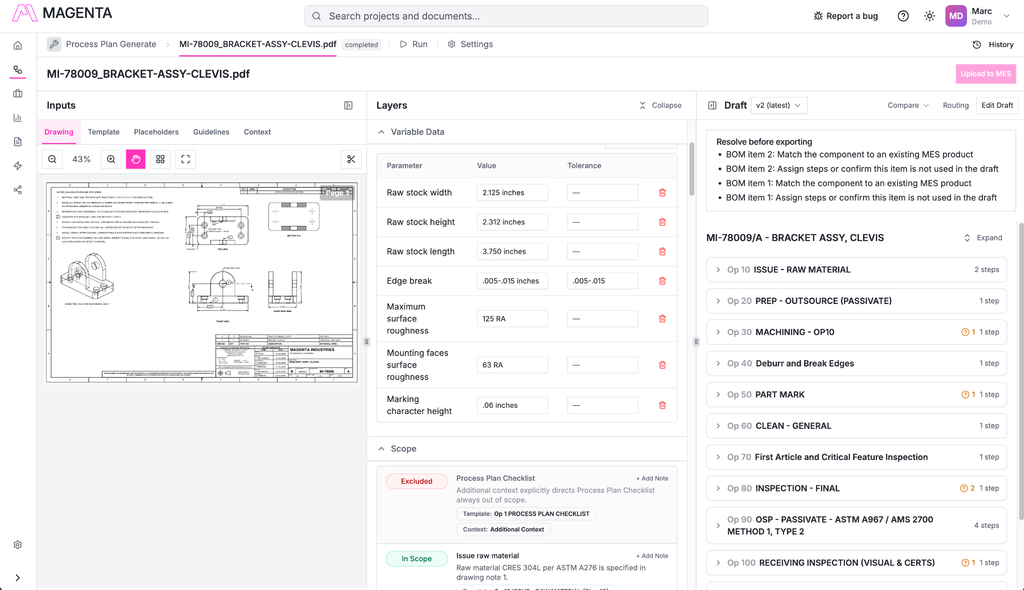
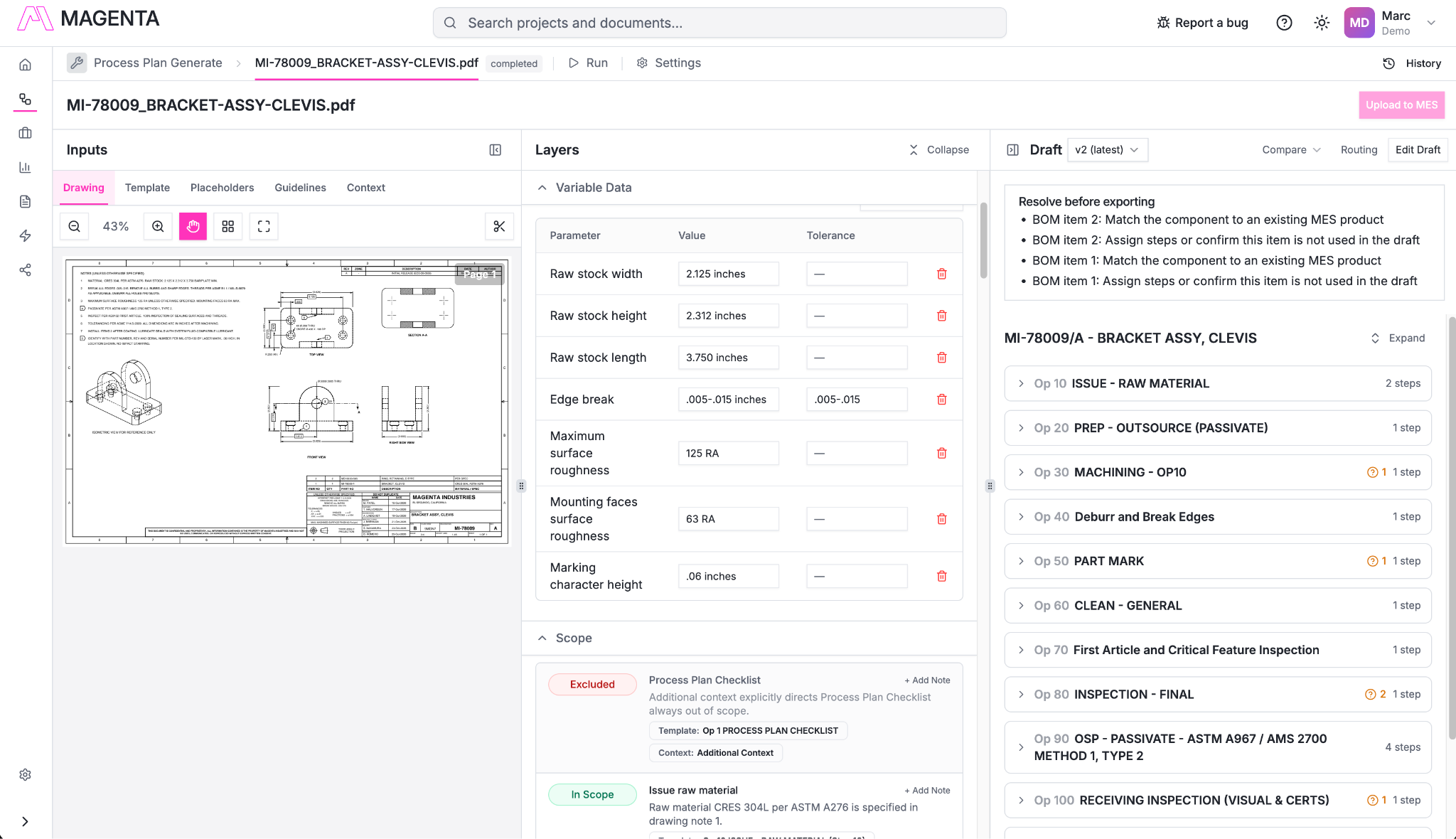
That is the fun thing about AI. A demo is very easy, but when you are dealing with quality departments and sign-off workflows people have to trust the system. So a lot of what we have built is not something the end user ever sees. It is evaluation engines, repeatability, and accuracy metrics for every workflow that runs. Early on, people would run a package through Magenta and say, oh yeah, this looks good. Then they would run it ten more times and ask why this one thing is different.
We get the same question at company level all the time. Someone says, yeah, I passed a drawing into ChatGPT and it analyzed it fine. Sure, but how do you prove it analyzed it properly, the same way every time, for a thousand people in your company? The answer is usually, I do not know, it looked like it did a good job this one time.
How do you measure that variation?
That was an early indicator that we needed to invest heavily in being able to calculate, with statistics, exactly what the variation is across running the same package or different packages. We have spent a lot of time and effort building that trust.
Keep the Thinking in the Drawing Room
Halfway through, Yaron turned the interview around and asked a few questions himself.
Yaron Alfi: Have you run into any of this yourself as an engineer?
Andreas Velling: I was in design, so the only documentation I really owned was drawings. Design for manufacturing was on me though, and a few times I got a call from the shop telling me to redraw things in a manufacturable way.
Yaron Alfi: That is actually a big motivation for me, because as a quality engineer we would get a lot of stuff from design that came out to manufacturing and could not be built. At one of the companies I was at before SpaceX, two parts needed to be bolted together, but there was no clearance to get a ratchet in. You could only get an open-ended wrench on it and turn one or two degrees at a time. Fifteen minutes per bolt, and there were fifty of them. That is why documentation is such an encompassing thing to me. Design is documentation. How do you validate some of it up front so the people downstream do not have a problem when it is their turn?
Andreas Velling: I really liked the principle my manager in the Netherlands introduced me to – keep the thinking in the drawing room. The drawings and the work instructions say everything, and no decision-making must be left to the shop floor.
Yaron Alfi: For sure. I have got into debates with people who say the technician should just have the 3D model. But the technician is not going to take a cross section in a JT viewer and see what the seal stack-up on the assembly is. You need a screenshot of that cross section with arrows pointing at it saying do not pinch these seals. There is a real split, where people want to move more of the thinking downstream. That makes sense in development, but in scaled production you need things as clear as possible.
Increase the Team Size or Increase Efficiency?
When did you start, and who is using it now?
We officially started in early 2025, and a good portion of that year was R&D, market research and working with early design partners. Our customers span automotive, aerospace, space, defense, and contract manufacturing. A big thing for us is not being seen as a solution for just one of them.
We believe there is a manufacturing blueprint every manufacturer abides by, regardless of what they are building. Processes differ, but every company buys raw materials, creates purchase orders and manages suppliers, and if they assemble something there is a traveler. Same concepts, slightly different flavors, and it is on us to smooth over the differences rather than get embroiled in customizations.
So no particular industry. Is there a type of company that fits better?
The slam dunk for us is companies starting to scale, where transactional volume is climbing. They are left with the question, do I double my team or make the people I have more efficient? Generally that is a hundred people or more. That is where you go from onboarding a supplier every three months to one a day, or a shipment every two weeks to one every five minutes.
A lot of manufacturers are bringing more work in-house instead of buying it from suppliers. Does that change who you can sell to?
For companies building everything themselves, it is a bet that it pays off, and the same goes for building software in-house. At SpaceX we built the software ourselves, and at ABL Space Systems, where my co-founders and I were after SpaceX, we made the same bet. It makes sense for things close to your core competency, or where the supply chains do not really exist yet or are weak. If a supplier gets overloaded by other customers you are not getting your parts, and that is a risk to the business.
Given how wide the offering is, there must be one thing that is always on the list. What is the biggest pain?
The supplier document package area, at least with the customers and industries we have focused on. You get a lot of documents with a wealth of information in them that are looked at for 45 minutes, thrown into a filing cabinet and never looked at again. So we generally start there and expand out.
Security Comes First
There is nothing about pricing on the site. Why not?
Right now it is all enterprise pricing, partly because customers require different levels of data security depending on what they do.
And it all runs in your cloud. How do you secure the data?
One thing we realized is that if you are doing any work in software for manufacturing in the United States, you are going to be working with people who end up doing some sort of defense work, or who have ties to things that require data security. So we made the decision to get FedRAMP early, which lets us build the trust to work with the customers we work with.
That whole framework is basically SOC 2 on steroids. Proper encryption, the boundary of your data, the policies for every employee, the training. We are on the FedRAMP marketplace and we have been through our equivalency audit. A lot of work, but definitely worth it.
Does that also stop people pasting drawings into ChatGPT on their own?
We do see that in some companies, from the ground floor up. Shadow AI, people using it even though they should not. Magenta gives them a safer way to handle their data and use AI, instead of throwing it at a model that will use their information to retrain itself. We have a lot of protections against that.
Making a Global Impact
Say you are really big in five years. What is behind the success?
Being agnostic. We sit on top of the different pieces of software, so we have a lot of partnerships with companies building ERPs, procurement software and manufacturing execution systems, and that is what lets us work with as many manufacturers as possible, because everybody is using different stuff. When you go and work at a company you do not get to choose what software you use. You just use it and figure out how to do your job. Magenta is modeled on that.
And what is the north star?
That we help great manufacturers build things they could not have imagined years ago. I have a lot of friends who started manufacturing companies, and when I hear the problems they have, they are all fixable.
They are usually not caused by physics. It is that they cannot work out how to get a machine running 24 hours a day, or they are debating whether they need a second shift or a third. I could have carried on, gone to another manufacturer and built more cool software, but my impact felt too local, and my co-founders felt the same way.
You were an engineer being sold to. Does that change how you sell?
Engineers are skeptical of software even without AI, and that is the world we play in. It helps being an aerospace engineer who worked on the other side, it builds a little trust, but in the end the software has to prove itself in use, so the bar is very high. We are not handing someone a piece of software and saying good luck. Whether you stay a customer or not comes down to whether it gives you a great outcome.
I am skeptical too. Whenever I got a demo from a software company I was the grumpy guy in the corner thinking, you just pre-loaded the best demo to show me.
Any other interesting AI companies in this space you would highlight?
There is a company I advise called Sift. They do data telemetry, taking data from sensors and analyzing it, and they have started introducing a bit of AI there.
There is Flow Engineering, and there is Manufacturo, building the next level of manufacturing execution system. First Resonance are in a similar space, and every day there are more popping up.
Related Topics
 Uliana Krayneva
 0
 Charlene Cohitmingao
0



Comment(0)