
en – Global
Knowledge & Community
Search
K
Quote & source your parts
Europe Europe
Türkiye Türkiye
United Kingdom United Kingdom
Global Global
select
navigate
switch tabs
Esc close

Thread & Tap Drill Size Calculator

Select the correct drill size for any tapped hole. Accounts for tapping method, workpiece material, thread engagement target, and blind hole depth requirements.

Tapping Method i
Target Thread Engagement % i
65%
75% Standard
50% (Hard Alloys) 85% (Soft Alloys/Plastics)
Hole Type
mm
Synced to minimum engagement depth - edit to override
Theoretical Tap Drill Diameter Tap Drill Dia
- Exact diameter from ISO 68-1 / ASME B1.1 formula
Recommended Stock Drill Bit Stock Drill Bit
- -
Min. Thread Engagement Min. Engagement
- -
Actual Thread Engagement Actual Engagement
- Engagement produced by the recommended stock drill bit

Cross-section view of the drilled hole wall relative to the full thread crest. The shaded zone represents material engaged in the thread

Workpiece Metal Engaged Material Drilled hole wall 100% Theoretical Crest Limit
Reference Charts & Data Downloads
Metric Tap Drill Chart
Thread Engagement Design Guide
UNC / UNF Drill Reference
Blind Hole DfM Cheat Sheet

Design for Manufacturability Notes

The 75% Engagement Rule

Moving from 60% to 100% thread engagement increases joint tensile strength by less than 5%. Tapping torque, however, increases by over 200%. For most applications, 65% in hard alloys and 75% in ductile metals delivers the optimal combination of joint reliability and tap longevity.

Hard Alloy Tapping Strategy

In tough materials like Grade 5 titanium and 316 stainless steel, thread pull-out is rarely the failure mode. Failure occurs in the bolt or at the bearing surface first. Setting engagement at 60 to 65% reduces cutting forces, extends tool life, and produces cleaner thread surfaces without sacrificing joint performance.

Blind Hole Depth: The 6x Pitch Rule

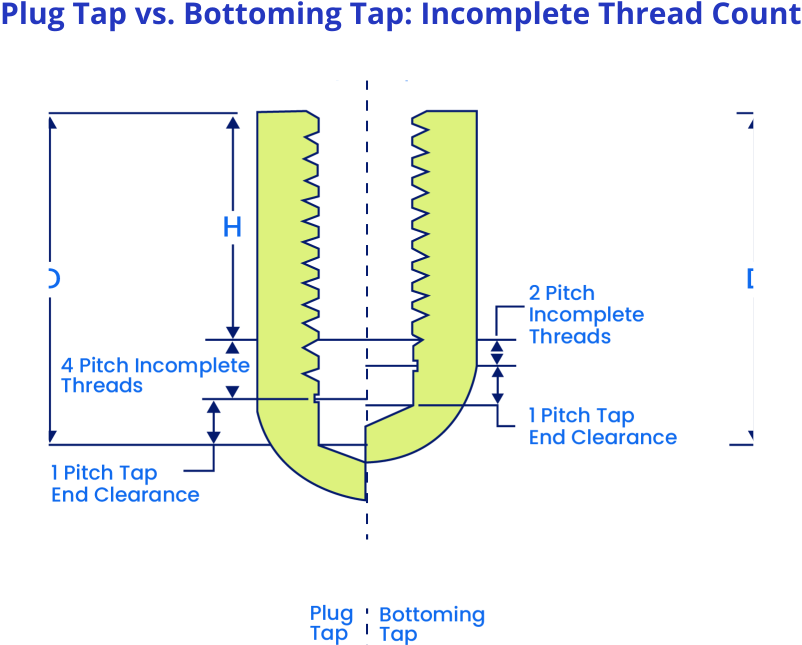
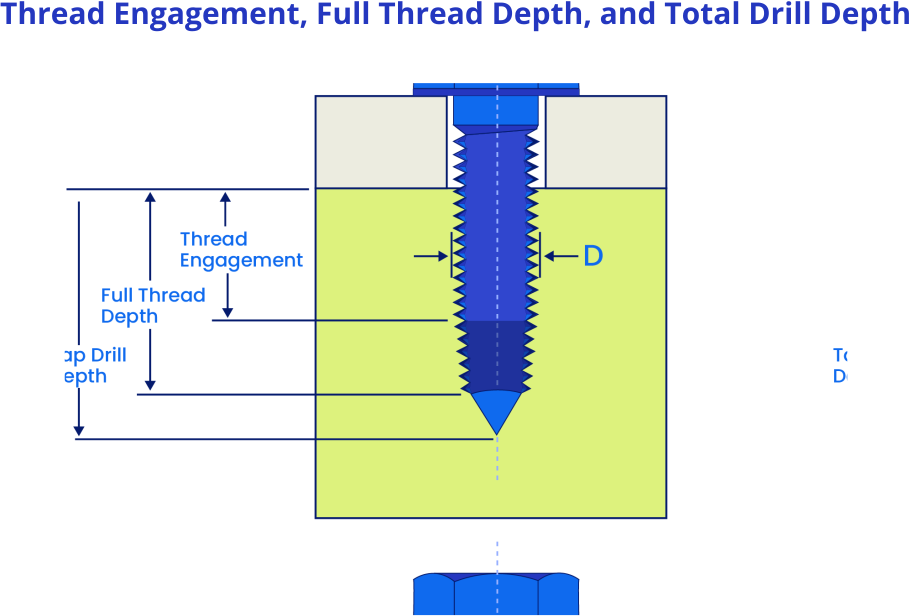
Standard commercial taps have 3 to 5 incomplete threads at the point lead before the full thread profile begins. Without sufficient clearance at the bottom of a blind hole, the tap contacts the floor before completing the required thread depth. Always drill to: thread depth + 6x pitch. Mark the required depth explicitly on blueprints.

Frequently Asked Questions

What formula does this calculator use for ISO Metric threads?

caret

For cutting taps: D = d_major – (1.082531 x P x % / 100)

For cold form taps: D = d_major – (0.5 x P x % / 100)

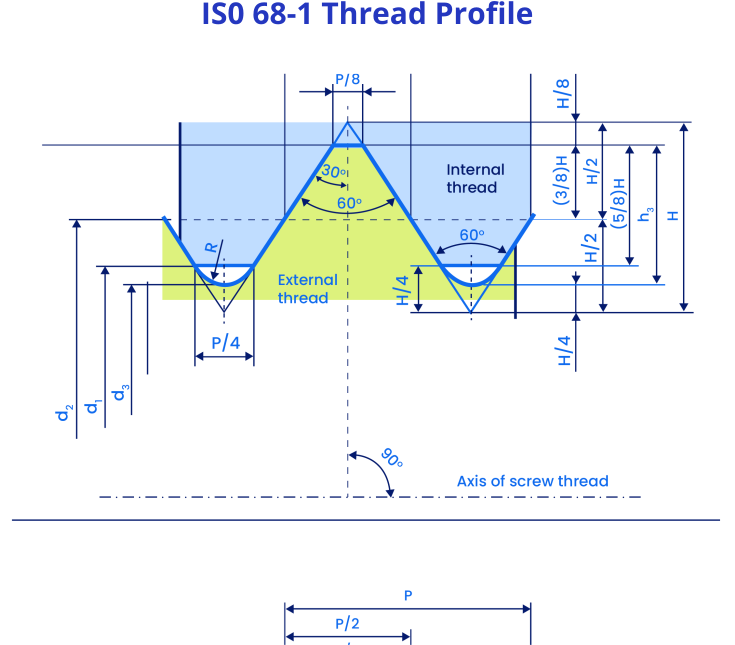
The constant 1.082531 derives from the ISO 68-1 basic profile: it equals twice the theoretical internal thread engagement depth, 5H/8, where H = 0.86603P.

How does the formula change for Unified inch threads (UNC/UNF)?

caret

The same geometric relationship applies, substituting threads per inch (TPI) for pitch.

Cutting: D = d – (1.082531 x %) / (100 x TPI)

Cold form: D = d – (0.5 x %) / (100 x TPI)

Since pitch in inches equals 1/TPI, these formulas are mathematically identical to the metric version and resolve to the same engagement depth ratio defined in ASME B1.1. Run both standards side by side in this calculator to confirm a converted print dimension before release to the shop floor.

Why does the calculator recommend lower engagement for hard alloys?

caret

In hard alloys, tap breakage is the dominant failure mode, not thread strip-out. Engagement above 65% adds disproportionate torque for negligible strength gain.

Engagement % Tensile strength (vs. 100% engagement) Tapping torque (vs. 100% engagement) Failure mode at this level
50% 91% 48% Tap breakage risk if material is work-hardening
55% 94% 56% Safe for Grade 5 Ti, 316 SS
60% 96% 64% Recommended floor for hard alloys
65% 98% 70% Recommended standard for hard alloys
75% 100% (baseline) 100% (baseline) Standard default, ductile metals only
85% 100.5% 142% No strength benefit, high breakage risk

What is the 6x pitch rule for blind hole design?

caret

Standard taps carry 3 to 5 non-full-profile threads at the tip, known as the lead chamfer. If hole depth equals only the required thread depth, the lead chamfer reaches the bottom before the thread is fully formed. Adding 6x the pitch to the drill depth provides clearance for the chamfer, chip accumulation, and a safety margin against tool contact with the floor.

Mark this extended depth explicitly on the engineering drawing rather than leaving it to shop interpretation, and confirm the resulting minor diameter clearance against the part’s stack tolerance using the ISO 2768 general tolerances when the hole sits near a critical wall section.

When should I use cold form tapping instead of a cutting tap?

caret

Cold form tapping suits ductile metals with elongation above 12%, including aluminum alloys, brass, mild steel, and copper. Benefits include zero chip evacuation, a work-hardened thread surface with improved fatigue resistance, and longer tap life.

Cold form taps are not suitable for hard alloys, cast metals, or engineering plastics, since these materials lack the plastic flow needed to displace material into the thread form rather than cut it. The pilot hole runs larger than for a cutting tap at the same nominal size; this calculator adjusts the recommended drill automatically when Cold Form / Roll is selected.

What is the difference between Theoretical Tap Drill Diameter and Recommended Stock Drill Bit?

caret

The Theoretical Tap Drill Diameter is the exact calculated size from the ISO 68-1 or ASME B1.1 formula at your target engagement percentage. This value rarely matches an off-the-shelf drill.

The Recommended Stock Drill Bit is the nearest commercially available size pulled from the standard ISO metric series (0.70mm to 80.00mm) or the Imperial series (wire gauge, letter, and fractional sets).

The Actual Thread Engagement card reports the engagement percentage that stock bit actually produces once rounding is applied, which is the figure to carry onto the production drawing rather than the theoretical one.

How does percent thread engagement actually affect joint strength?

caret

The 75% default is a conservative legacy figure from general-purpose steel and aluminum applications, not a hard physical limit.

Engagement % Tensile capacity (relative) Marginal strength gain per 5% step Tapping torque (relative) Tap breakage risk
50% 87% 44% Low
55% 91% +4% 52% Low
60% 94% +3% 60% Low
65% 97% +3% 70% Moderate
70% 99% +2% 84% Moderate
75% 100% +1% 100% Elevated
80% 100.3% +0.3% 122% High
85% 100.5% +0.2% 148% High

For fastener-critical joints, size the engagement target from the actual bolt tensile stress area in the bolted joint calculator rather than defaulting to 75% out of habit.

Why is the pilot hole larger for cold form taps than for cutting taps?

caret

A cutting tap removes material to form the thread profile, so the pilot hole only needs to clear the tap’s minor diameter. A cold form tap displaces material radially outward into the thread form without removing any of it, so the starting hole has to be close to the finished pitch diameter or the displaced metal has nowhere to go.

Undersizing the pilot hole on a form tap spikes torque dramatically and is the leading cause of form tap breakage in production. This calculator’s automatic pilot hole adjustment for Cold Form / Roll selection exists specifically to prevent that error.

Why doesn't the calculator return a drill size that exactly matches the standard tap drill chart on my shop wall?

caret

Most printed tap drill charts hardcode a single engagement percentage, typically 75%, and round to the nearest common fractional or metric size without showing the underlying math.

This calculator computes the theoretical diameter at your specified engagement percentage first, then separately maps that to the nearest stock bit, so any deviation from 75% or any non-standard material selection will shift the recommended size away from a generic wall chart. Treat the wall chart as a 75%-engagement special case of this calculator’s broader output, not a contradicting source.

Can I use this calculator for threads in plastic or composite parts?

caret
Material class Tap type Engagement % range Elongation at thread root Why
Ductile metals (Al 6061, brass, mild steel) Cutting or cold form 65-75% >12% Plastic flow supports form tapping
Hard alloys (stainless, titanium, tool steel) Cutting tap only 50-65% 2-8% Insufficient ductility for form tapping
Engineering plastics (Delrin, nylon, PEEK) Cutting tap only 50-60% <2% at thread root Cracks under radial displacement
Filled composites (glass/carbon-filled) Cutting tap only 45-55% <1% Fiber pullout under form tap loading

Engineering plastics behave more like hard alloys than ductile metals: minimal elongation at the thread root makes them prone to cracking under cold form displacement. Avoid Cold Form / Roll for thermoplastics or filled composites regardless of the percentage entered.

Does the desired thread depth field account for the tap's chamfer length automatically?

caret

Yes, when the field is left synced to the calculator’s default. The depth value updates automatically to the minimum engagement depth plus the appropriate chamfer clearance whenever you change thread size, tap type, or hole condition.

If you manually override the depth field, the calculator flags it as a custom value and stops auto-syncing, since at that point you are asserting a specific shop or drawing requirement that should not be silently recalculated.

Ready to manufacture these parts?

Upload your 3D model to the Xometry Instant Quoting Engine for DfM feedback, material options, and pricing in seconds.

Get an Instant Quote