

 Europe
  Türkiye
  United Kingdom
  Global








 Login with my Xometry account
 Bolted Joint Calculator (Tap Drill, Clearance Hole & Stress Area)
 Clearance Hole (Top Plate)
 Tensile Stress Area
Effective cross-sectional area used to calculate bolt tensile strength and preload capacity
 Tap Drill (Bottom Hole)
Recommended drill diameter before tapping to achieve ~75% thread engagement
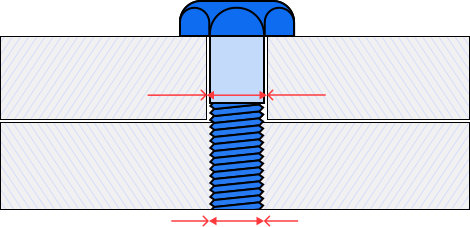 TOP PLATE
BOTTOM PLATE
TOP PLATE
BOTTOM PLATE
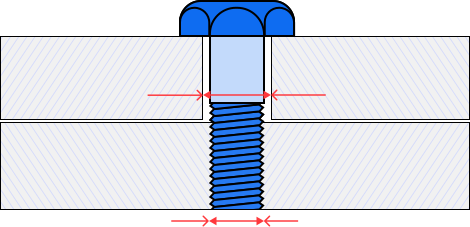
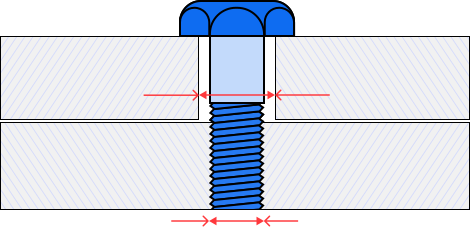
Clearance Hole: Ø —
Tap Drill: Ø —

Data based on ISO 273 (Clearance), ISO 286 (H13/H12/H11), and ISO 898 (Stress Area). Values are for reference only. Xometry assumes no liability for design failures. Final design validation must consider material strength, joint geometry, load conditions, and safety factors.
Frequently Asked Questions
How are Close, Normal, and Loose clearance fits defined?

- Close Fit: Optimized for precision assemblies where alignment is critical. It requires tighter manufacturing tolerances on hole locations to ensure bolt passage.
- Normal Fit: The industry standard for general engineering applications. It provides a balance between ease of assembly and joint security, accommodating standard CNC or manual machining tolerances.
- Loose Fit: Best for large weldments, parts with wide tolerances, or assemblies subject to thermal expansion. It is also used when aligning multiple bolts across a large surface area where “hole wander” may occur.
What bolt size and fit should I use for different applications?
The optimal bolt fit depends on the level of precision, assembly conditions, and tolerance requirements.
The table below shows typical applications for common bolt sizes and fit types:
Typical Bolt Fit Applications
| Bolt Size & Fit | Application Type | Why This Fit is Used |
| M6 + Close Fit | Precision fixtures, jigs | Ensures accurate positioning and repeatability |
| M8 + Normal Fit | General machine assembly | Balanced assembly ease and joint stability |
| M10 + Close Fit | Alignment-critical components | Minimizes positional error in assemblies |
| M10 + Normal Fit | Mechanical structures, brackets | Standard choice for most engineering designs |
| M12 + Loose Fit | Structural frames, welded assemblies | Allows tolerance stack-up and easier alignment |
| M16 + Loose Fit | Heavy machinery frames | Accommodates large parts and installation variation |
| M20 + Loose Fit | Steel structures, construction assemblies | Handles misalignment and thermal expansion |
Tap Drill vs Clearance Hole: what’s the difference?
A Tap Drill creates the hole that will be internally threaded (tapped) to accept a bolt; it is sized to allow for roughly 75% thread engagement.
A Clearance Hole is a non-threaded hole in the mating part that allows the bolt to pass through freely.
What is the Tensile Stress Area of a bolt?
The Tensile Stress Area is the effective cross-section used to calculate bolt strength.
- Smaller than nominal diameter
- Larger than minor diameter
- Used in ISO 898-1 and ASME B1.1
Why use Tensile Stress Area instead of the Minor Diameter?
Using the minor diameter alone underestimates the bolt’s actual strength. During tension, the thread flanks share a portion of the stress. Engineering standards (ISO 898-1 and ASME B1.1) utilize the Tensile Stress Area to provide a more accurate, empirically validated calculation for safety factors and torque-tension relationships.
How is the Tensile Stress Area calculated?
The formulas vary slightly between Metric and Unified (Imperial) standards to account for thread geometry differences:
- Metric Threads (ISO 898-1):

- Unified Threads (ASME B1.1):
 (Where ‘d’ is nominal diameter, ‘P’ is pitch in mm, and ‘n’ is threads per inch).
 - Unified Threads (ASME B1.1):
 (Where ‘d’ is nominal diameter, ‘P’ is pitch in mm, and ‘n’ is threads per inch).



Does this calculator account for Fine vs. Coarse threads?
Yes. By selecting the specific pitch (Metric) or TPI (Unified) in the “Select Bolt Size” menu, the calculator automatically updates the Tensile Stress Area and Tap Drill requirements. Fine threads typically offer higher tensile strength and better vibration resistance, while Coarse threads are more robust for rapid assembly and stripping resistance in softer materials like aluminum.
What standards are used for these calculations?
Our tool references ISO 273 for clearance holes, ISO 724/898 for Metric thread profiles, and ASME B1.1 for Unified (UNC/UNF) Inch threads. These ensure your designs align with global manufacturing and inspection requirements.