

 Europe
  Türkiye
  United Kingdom
  Global








 Login with my Xometry account





The co-founder and CEO of Ballista Labs, Cameron Buccellato, told us why there is more engineering to be done than engineers to do it, how the company’s agent Orville designs for manufacturability rather than just shapes, and where AI-driven engineering goes in the next five years.
Infinite Engineering, Finite Engineers
What is the problem you are out to solve with Ballista Labs?
There is an infinite amount of engineering to be done and only a finite number of engineers, with a finite amount of time. We have worked in engineering companies as mechanical and fluid engineers, and we saw the same thing everywhere. When you finish one set of work, the company already knows what needs to come next. The bottleneck is always the speed at which engineers can do it. So if you put LLMs to work on real engineering tasks and outcomes, you accelerate the rate at which humanity can do engineering.
When you say “we,” who is building this?
There are two of us right now, myself and Ethen Daniels. We are the two co-founders and a lean team, no other employees.
You have both worked at big-name companies like SpaceX and Blue Origin. What is your personal motivation?
We like pushing the frontier, building things that have never been done before but are genuinely useful. About a year ago we realised LLMs were going to be able to perform engineering, and that it would change how engineering gets done. We wanted to be the ones to make that happen, to get AI performing real engineering work end to end.
Maximum Design Freedom Gives the Best Results
And what’s your solution to combat this lack of engineers?
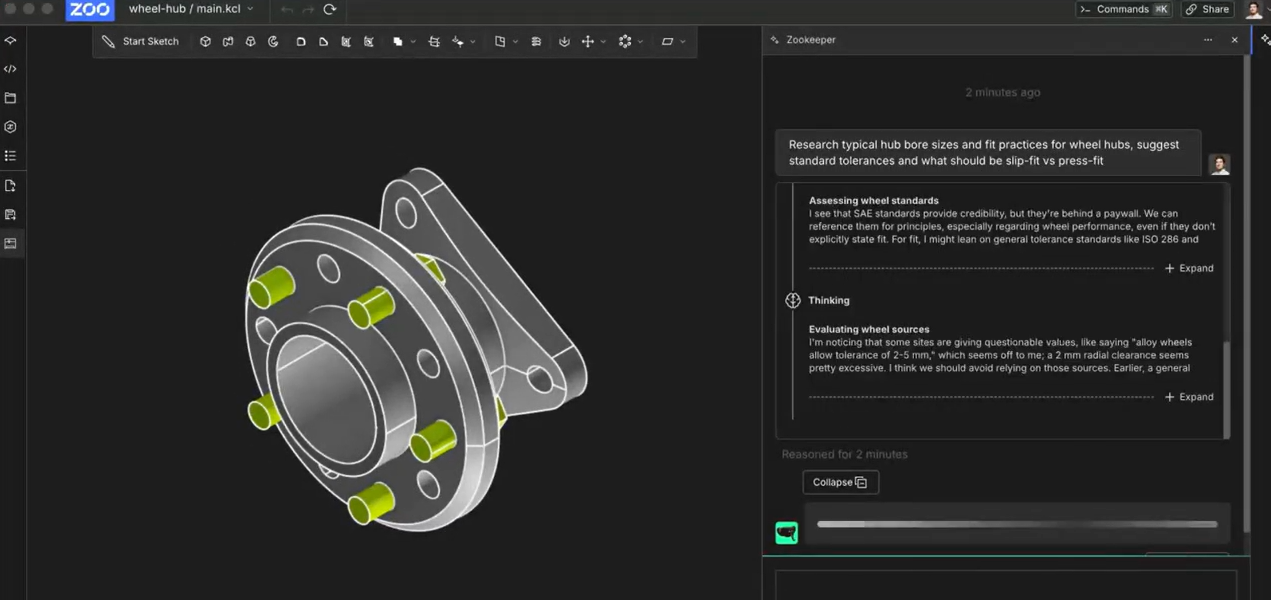
It is an AI agent with a workflow built from scratch for engineering design. It produces coherent 3D designs that are well engineered at a high level but also sound spatially, and it focuses on making parts that are actually manufacturable.
That distinction matters when you see how LLMs naturally work. Ask Claude Code or Codex to do a 3D design task and a lot of the time you get something with the essence of a design, but at the granular level everything is a rectangle, a circle, or a cylinder. It is not something you could actually manufacture. Orville is built to produce real, manufacturable designs that fully satisfy the project.
How large a project can it handle?
We deliberately keep it to smaller projects, right now anywhere between 3 and 10 unique parts in an assembly. Any more than that and the complexity gets to be too much. Keeping projects small means it actually finishes them to a standard worth manufacturing and testing in the real world.
Manufacturability depends on the process. Can I, as the user, say which processes are available to me?
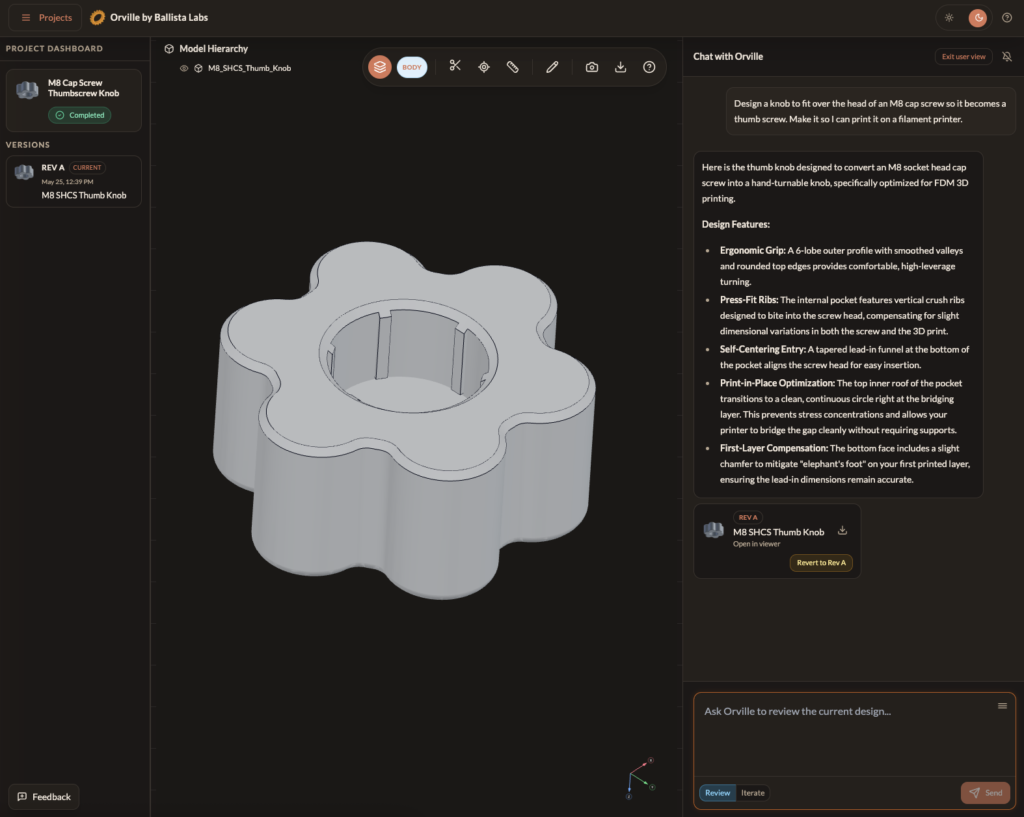
Yes, and it is best if you do. If you are at a company with a full machine shop at your disposal, say so, along with the technical labour and manufacturing space you have. If you are a hobbyist in your garage with basic tools, say that too, because you will need to outsource to a CNC or 3D printing service.
A high-production injection-molded component comes out differently than a one-off prototype you are going to 3D print. And if you do not specify, Orville picks the most sensible process for the project.
It is an AI product. Are there still hardcoded rules for specific manufacturing methods?
We do not really have hardcoded manufacturing rules. We lean on the LLM’s understanding of manufacturing processes, since it can handle a huge range of them. What we set are the philosophies in the prompting and the experience the agent carries, where the first and foremost goal is always manufacturable parts that are safe and satisfy the function of the project. LLMs are intelligent enough to apply the right rules situationally from their understanding of each process.
Are those rules just whatever the model knows today, or did you feed it thick handbooks on design for manufacturing as a backbone?
It is mostly what the models already know, and today that is a lot. Opus 5, Fable 5, Gemini 3.6 Flash, GPT-5.6 all have an extremely deep understanding of design for manufacturability. Cumulatively I would say it is deeper than many seasoned engineers. You can always find a specific area where a seasoned engineer knows something the models do not, but broadly they are remarkably knowledgeable. And if the agent is missing a specific piece of knowledge, it can always run an internet search to fill the gap.
Is the output truly production-ready, or is it 80% done and for me to import it into my own CAD to finish?
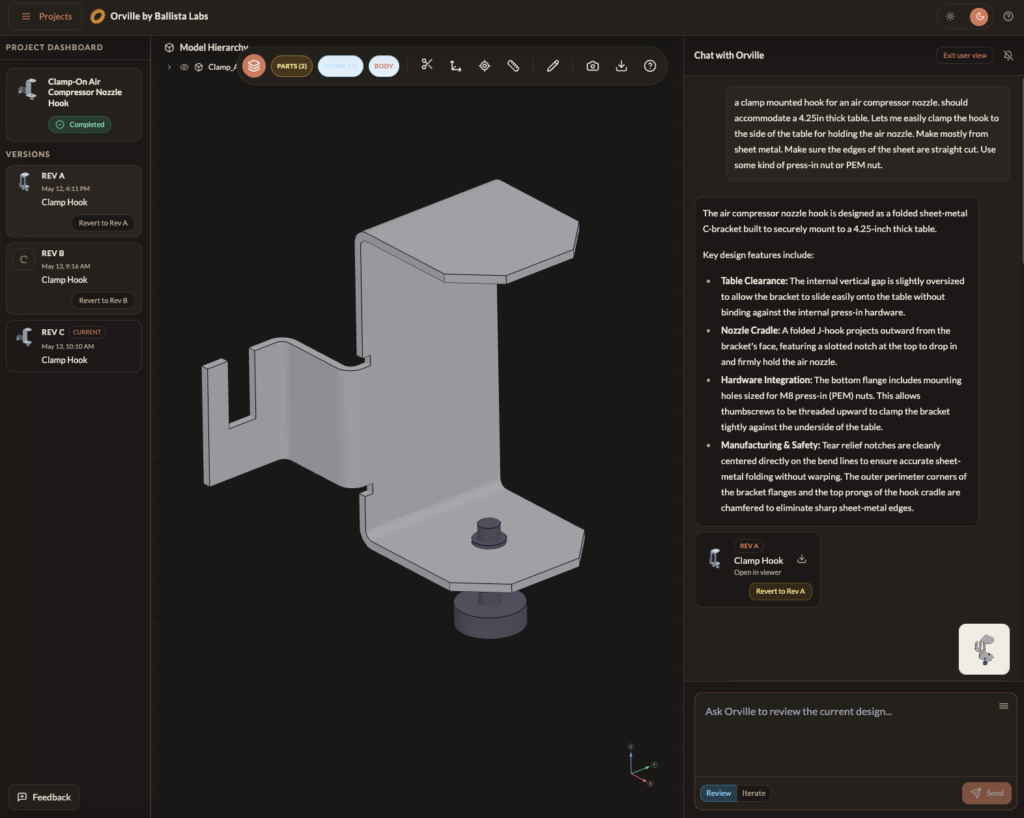
The goal is that outputs are 100% production-ready. We can’t give out a guarantee, because as with any AI product the user has to review and certify the design before moving forward, just like with AI coding tools. But the intent of the workflow, and the most frequent outcome, is a design that is either fully production-ready or very nearly there, needing only a few tweaks. Those tweaks come as a follow-up prompt, not by opening your own software and editing manually. If I am doing a CNC part and it comes back almost ready, but there is one small thing a machine shop might catch, I give that as feedback and it updates the design.
If you have CAD skills, isn’t making the changes yourself easier than a continuous flow of prompts?
It is not really a continuous flow. Most jobs are a single prompt laying out what you want, then usually zero follow-ups, maybe one or two. It is not long, cascaded prompting.
So what makes a good prompt?
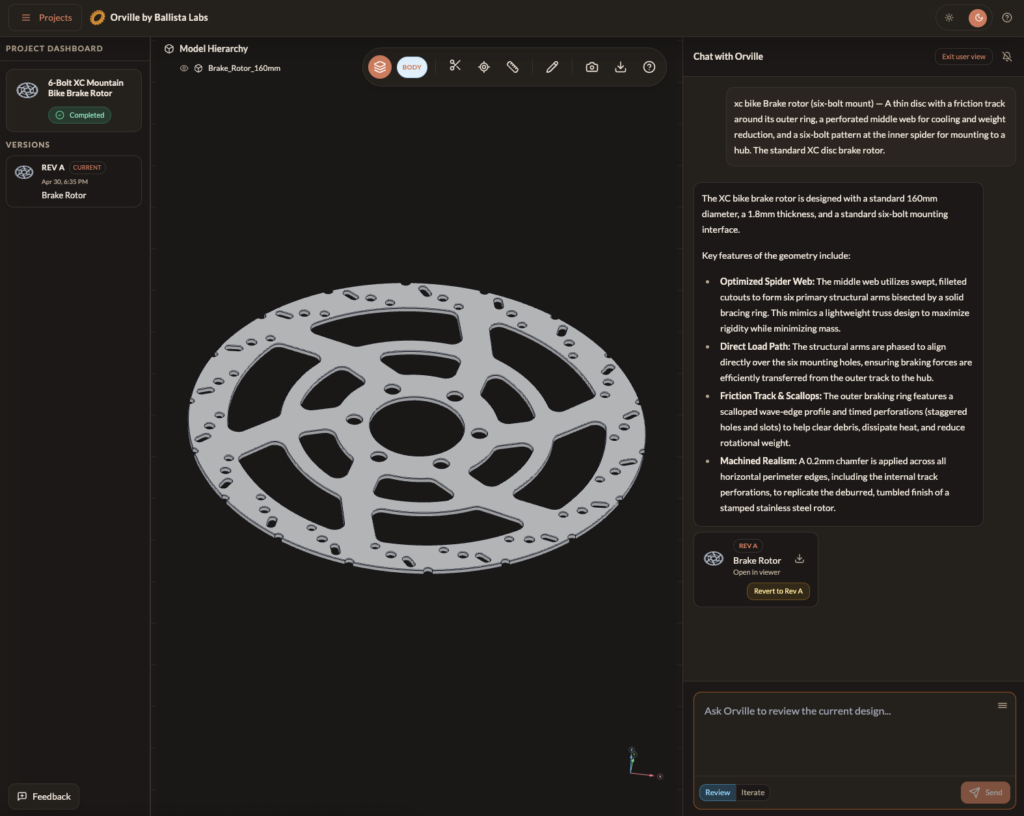
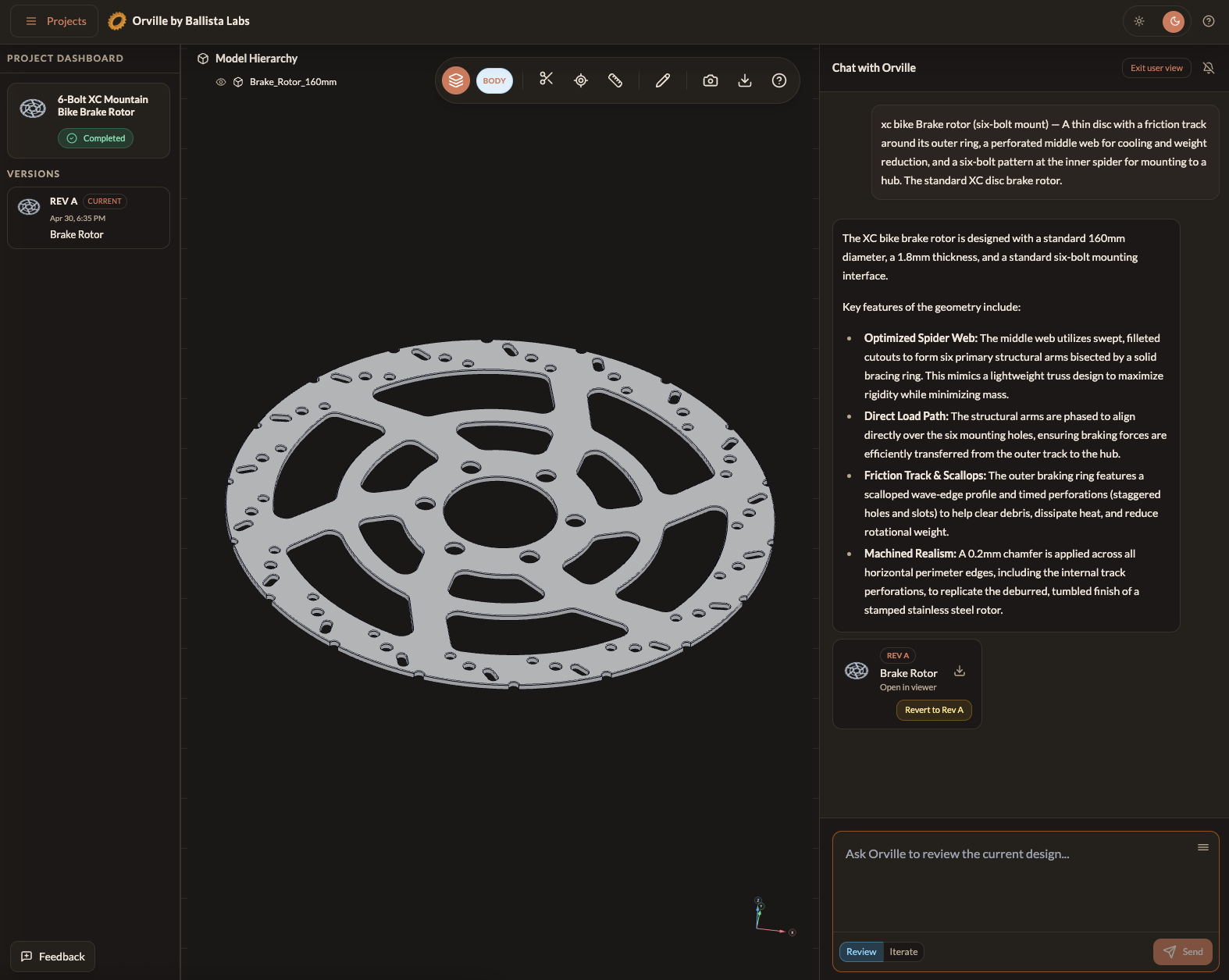
Describe what the project is, what it is supposed to do, and what problem it solves in the physical world. Then, if it makes sense, add a few requirements, though those usually follow the “why”. Every engineering assembly exists to solve a physical problem, so if you describe that problem, the constraints, how you will build it, and who you are, the agent reasons from there to the real under-the-hood requirements and starts designing.
What you do not want is to invent a list of arbitrary requirements for their own sake and hand that over. If you have a half-finished project you can share what you have, but do not do the pre-engineering yourself and pass it in, because then the agent is boxed in by your work. When it does its own engineering from scratch, the outcome is almost always better.
What input formats can I work with?
Both text and images. Text does most of the work, and about one in five jobs we see also uses an image. Images are usually not required, but if you have a visual idea you cannot put into words, say a table lamp you want to look a specific way, you can bring it in. We also have a sketching feature on the website, or you can upload reference material or any imagery you want.
Your web says Orville provides basic analytical results and margins for structural and thermal performance. How reliable are those?
Orville does some limited analysis and calculations while building, but we do not present those as official, ready-to-test results. That distinction matters. If safety or high energy is involved, that is not an assurance we can give. The user has to do their own verification and own the design.
The tube routing agent will go further, producing analysis reports the user can double-check or build from. But either way, the agents design with calculations involved, they do not hand you a certified design. That verification is always on the user.
Tube Routing as the First Niche Use-Case
You mentioned an agent for tube routing. How does it relate to Orville?
The way I look at it, Orville is the generalist that can handle any task, and the fluids routing agent is very similar but purpose-built only for tubing. It does those tubing tasks well, quickly and effectively. We zoomed in on that specific need and made sure it has everything required to solve those jobs. You can think of it as a specific capability of Orville.
What exactly is the pain point in tube routing today?
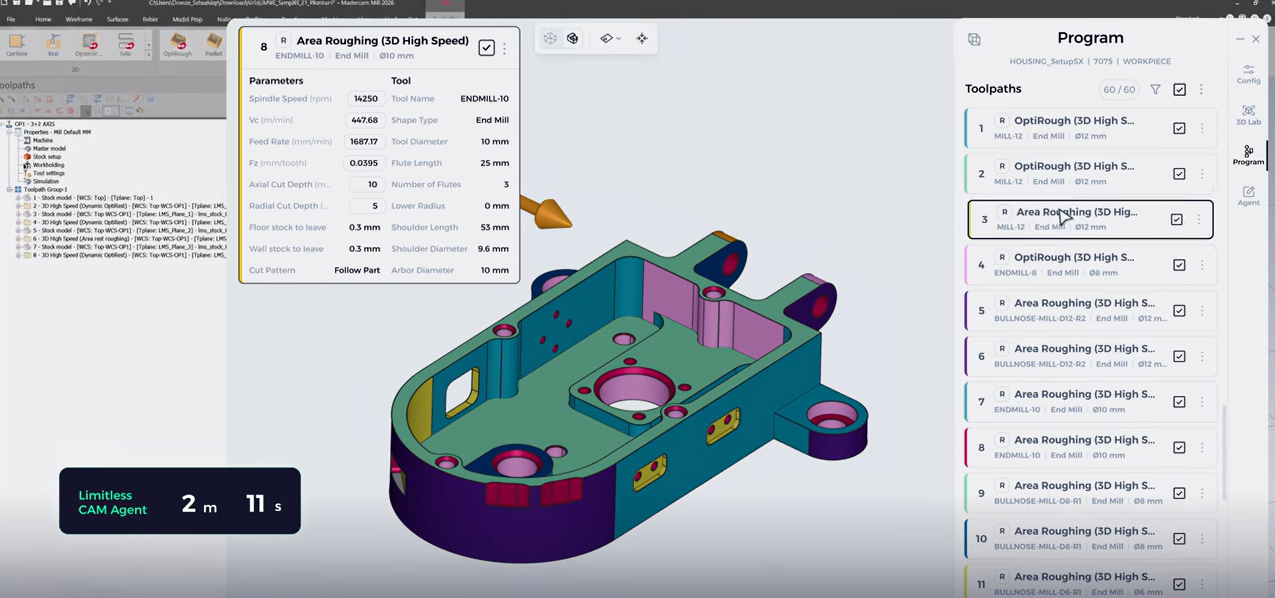
Fluid systems live in the CAD environment. By this point the engineer has already designed the system at a high level with a plumbing and instrumentation diagram and brought in third-party components like valves. What is left is routing the tubes, building the individual routes that carry fluid from one place to another. These are numerous, anywhere from 20 to a few hundred in a single assembly. CAD products do not serve this well. It is tedious, time-consuming, and not the bread and butter of the engineer, who would rather be designing the system at a high level. The agent steps in and automates that work very quickly. It is the first specific tool we are building for enterprise.
Is it a separate product, or does it sit on top of Orville?
It will launch as a separate product, but under the hood they are pretty similar. The longer-term goal is to build out specific, high-value capabilities like tube routing, and then let the enterprise user prompt Orville for any task and have it call on all of them at once. A single large project might involve structural frames, fluid components, tubing, avionics harness routes, and free-form component design. Orville brings all those skills together to handle the kind of job you would see at an aerospace company, with fluids, structures, and avionics in one place.
Be Better Than Their Engineers – the Threshold for Adoption
Who is using Orville today?
We have a set of repeat consumer users, and about 1,000 people have tried the product at least once. Right now we are shifting focus to enterprise. We will keep building and maintaining Orville for consumers, but the priority is enterprise, because consumers do not as often have engineering they need done. That work sits on the enterprise side, and as our agent gets more capable it is more and more a match for it.
We are in talks with enterprise engineering companies, mostly in aerospace, about how they want tubing done and how they want AI integrated, and we are in the middle to late stages of building that tubing product so we can deploy it with them.
Is all-purpose text-to-CAD too hard to build to be useful for engineers?
I would not frame it that way. With Orville we built a generalist that takes a project from a high-level brief all the way to completion, keeping the scope small so it could work effectively. But engineering companies are rarely starting from scratch. They are working on very large, very complex projects that need specific engineering tasks done inside them. So a from-scratch designer is not what they need the way a hobbyist builder would.
What enterprise needs are niche capabilities of very high quality. An AI agent has to be better than their own engineers, otherwise they would just have their engineers do the work. That is a high bar. A consumer wants to build a small project from scratch. Enterprise is running very large projects for years, and that is a different need entirely.
Where do hobbyists fit in?
A hobbyist, or even someone who would never call themselves a builder, might just need a cup holder to mount in their home theatre and a file to 3D print. Orville produces it, even though they have probably never touched a CAD program in their life. It brings design and engineering ability to people who are not designers or engineers, the same way AI coding tools bring software engineering to people who are not software engineers.
I tested Orville with “design a holder for an iPhone 15 I can use in my car regardless of the car model.” It was interesting to see how it solved the “regardless of” part, attaching into the cup holder with a circle of flexible fins. It also told me which materials to use, ASA for the body and TPU for the fins sleeve.
It really comes up with ideas on its own. Sometimes it draws on history and conventional designs, other times it makes something completely new. And it gets you prepped for actually building it. Go into an instant-quote 3D printing service and you know exactly what to select and have it queued up ready to build.
What are the most common things non-engineers get done with Orville?
It is a huge mix, almost impossible to put in one category. A lot of it is things for the home or garage, a custom guitar stand or wall mount, or a small part to go along with whatever someone is tinkering on in the garage. Having so many people test it is useful, because we get to see what people actually want.
And one clear pattern has come out of that – people want large projects. Whenever we show what Orville can do on LinkedIn or the website, people consistently ask for something a level up, projects with 25 components, above what we are advertising. So it is not very complex single parts or high volumes of small things they are after. They want large, complex projects done in one go.
Priced Against a Freelance Engineer
Your website lists prices. What do I get for $100 worth of credits?
For $100 of credits you can build maybe 5 to 10 moderate-complexity projects, or around 5 if you are doing a lot of back-and-forth iteration. Hand that same prompting to a traditional engineering design service, or one of the freelance engineering platforms online, and you would probably pay $300 to $500 per project. With Orville the same project runs maybe $20 to $50 of credits.
What about pricing for enterprise?
Enterprise is license or seat-based, stable month-to-month, and much higher than consumer. With enterprise you are pricing against business value. You get work done that would otherwise take highly paid engineers many hours, and you get it fast instead of waiting for it to sit queued. You are also freeing your engineers up for more important or more difficult work. That is what the pricing reflects.
Where does my design data live?
It is secured on a professional cloud platform. Some of it does get passed to frontier LLMs, because that is how the product works, it is an LLM agent. So platforms like Google, Anthropic, or OpenAI receive that data and handle it under their own security practices.
You have plugins for FreeCAD and Fusion. Tell us about those.
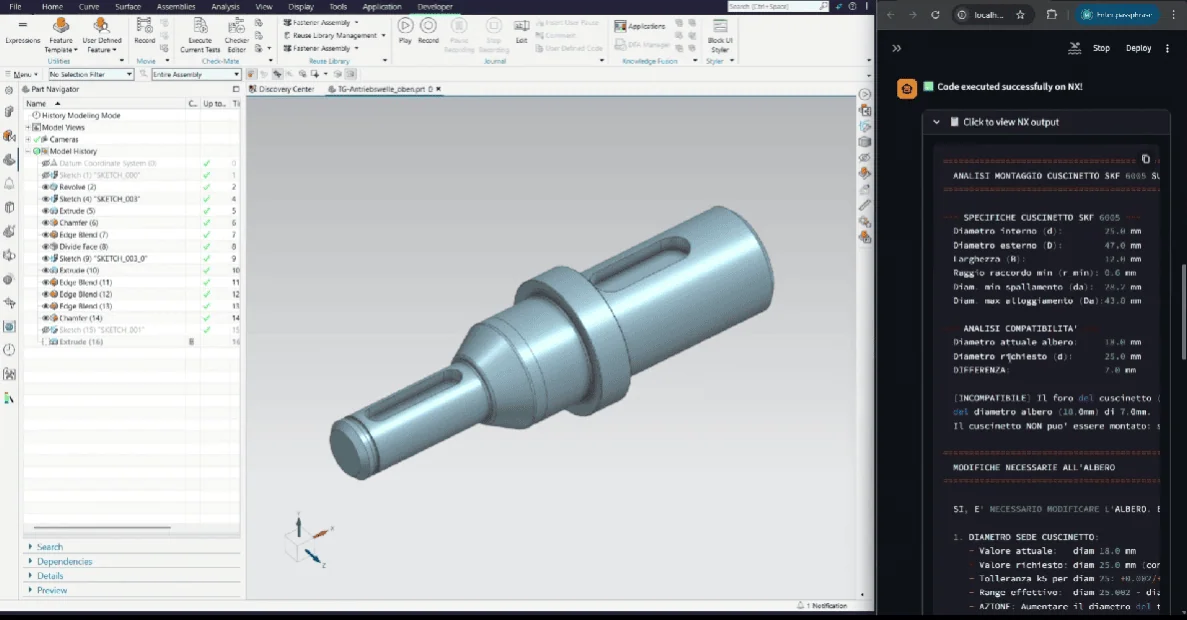
We started with Orville on the website as the full experience. But some users already have their way of working, maybe in FreeCAD or Fusion, and they do not want to switch interfaces for it, especially when they have other, non-AI projects running in the same tool. The plugins let them use Orville wherever fits how they already work. We have built a few so far and not yet covered every CAD package, so that is ongoing.
Five Years to Megaprojects
You say companies need niche capabilities, and tube routing is the first you are tackling. What is next?
We would move up the ladder of what a fluid system engineer does. A fluids engineer starts high-level with a plumbing and instrumentation diagram, deciding what the system should do, where the fluid moves, and what pumps and heat exchangers it needs. Then they select the actual components, bring everything into the CAD assembly, integrate it with the larger project, and route the tubes. Right now we are starting with the tubes, because that is the piece engineers would trust an AI agent with first. From there we take on the full stack of what a fluids engineer does.
Your vision talks about megaprojects for the benefit of humanity. How far away are we?
I would say 5 years from very large projects being done end to end by AI agents with minimal human input. That might sound soon, but LLM capability is growing at an exponential rate, and we have felt it firsthand, having been blown away by the improvements in just the last year. On top of that there are big gains on the tool-use and agent-harness side, and in what we have built. Put those together and in 5 years I think agents like this will be handling very large design projects, on the order of 1,000 to 5,000 components in a system.
Any other interesting AI companies in the space worth keeping an eye on?
I have been impressed with some of the individual efforts in AI CAD I have seen on X. A few people are bringing CAD and 3D design capabilities into Codex or Claude Code, more as skills and prompting frameworks, and that work has been really good. On the company side, PhysicsX stands out, bringing targeted solutions into CFD and structural analysis with big gains in both iteration time and quality. They are tackling one specific part of the engineering process, and there are a few others in that space doing the same well.
Related Topics
 theprintede electronics
 0
0
 Javier López Picazo
2
Javier López Picazo
2



Comment(0)