

 Europe
  Türkiye
  United Kingdom
  Global








 Login with my Xometry account





We talked to the CEO of Authentise, Andre Wegner, to understand the communication problems in the industry and how Authentise Threads is solving them.
From a Plane Crash to a Software Company
You founded Authentise in 2012 after a plane crash in Nigeria. How did that become part of the founding story?
I used to run a fund in Nigeria. In June 2012, an aircraft crashed on approach to Lagos and killed 159 people. They flew even though there were parts that needed replacing but weren’t available.
If spare parts had been available locally, the pressure to keep flying a compromised aircraft would have been lower. That’s what got me thinking. We need to be able to manufacture parts closer to where they’re needed, when they’re needed. That became the basis of founding Authentise and my conviction hasn’t changed.
We Generate, Capture and Lose Intent
Engineering teams already have tools like Jira, Slack, Teams, Confluence, PLM systems for communication. What’s missing?
The artifacts of the mechanical engineering process are drawings, reports, 3D models. Those are sufficient to manufacture the part for a very specific set of manufacturing capabilities. But they’re insufficient to make even minor changes, because they don’t communicate the intent behind the requirements.
Slack, email, PowerPoint, all those sources of intent do exist. But they’re lost the moment the project is finished. The only thing that remains is the drawings and models. So we generate intent, we capture intent, and then we lose intent. Our belief is that intent is extremely valuable.
What does that mean in practice?
Take reverse engineering. If you have a plane first made in the 1950s, and you want to update a part for a new manufacturing process, you need to redesign and recertify it. You have to understand why the original engineers made the decisions they made. Were they limited by the machines available at the time, or does the part genuinely need that tolerance? Without intent, you have to design the product from the ground up just to understand the constraints.
So the engineer is basically looking at the part and trying to rebuild all the logic on his own, without context from the people who originally designed it.
Exactly. And you can see how this plays out in 3D printing. A lot of companies would love to switch older parts to additive manufacturing, but they can’t. The original design files only tell you what to make, not why it was made that way. Without that context, it’s safer to stick with whatever manufacturing process was specified in the original drawings. If intent existed, 3D printing would be ten times as big as it is now.
Making Project Info Accessible and Interactive
Explain Threads to a skeptical engineer.
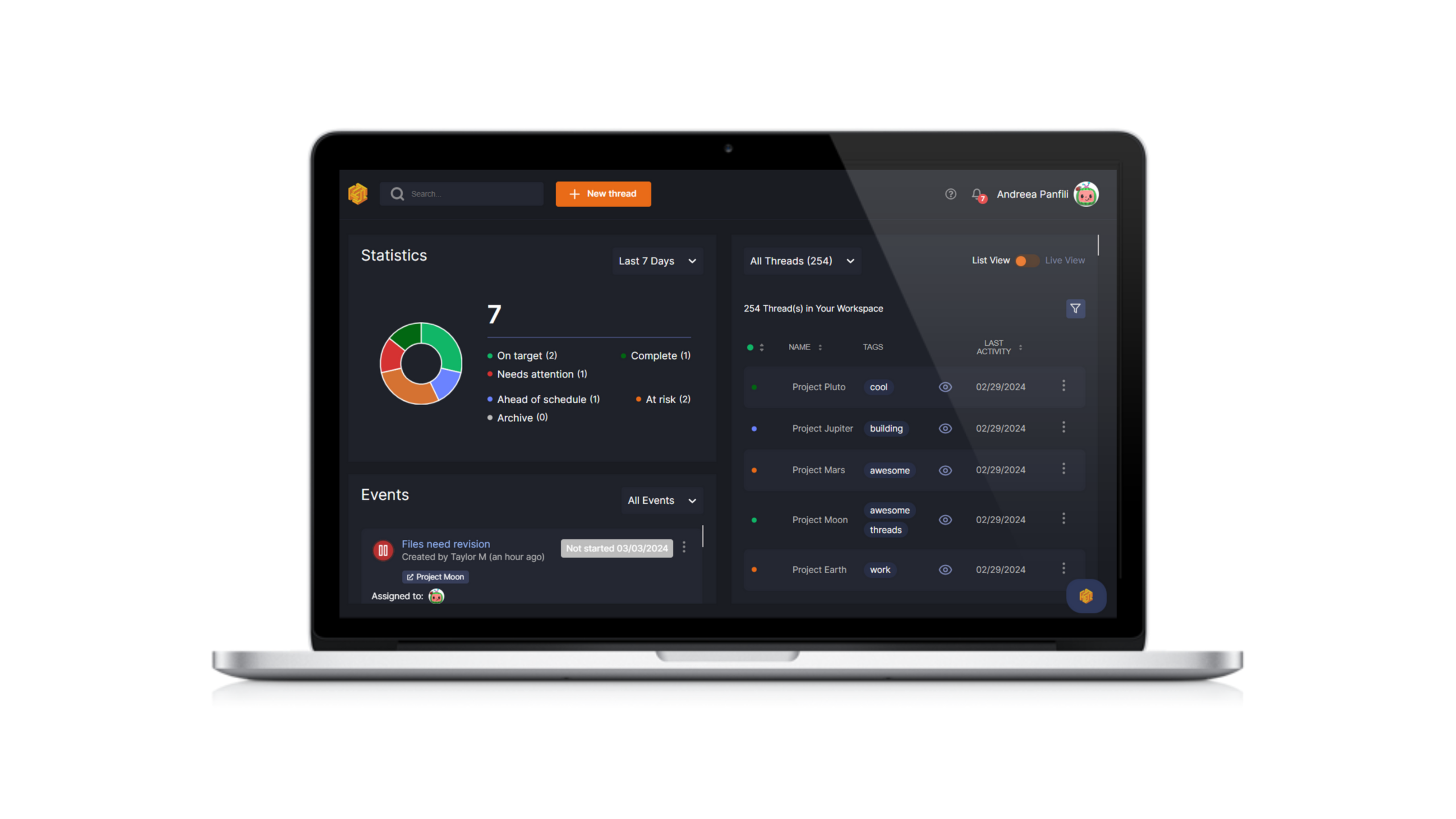
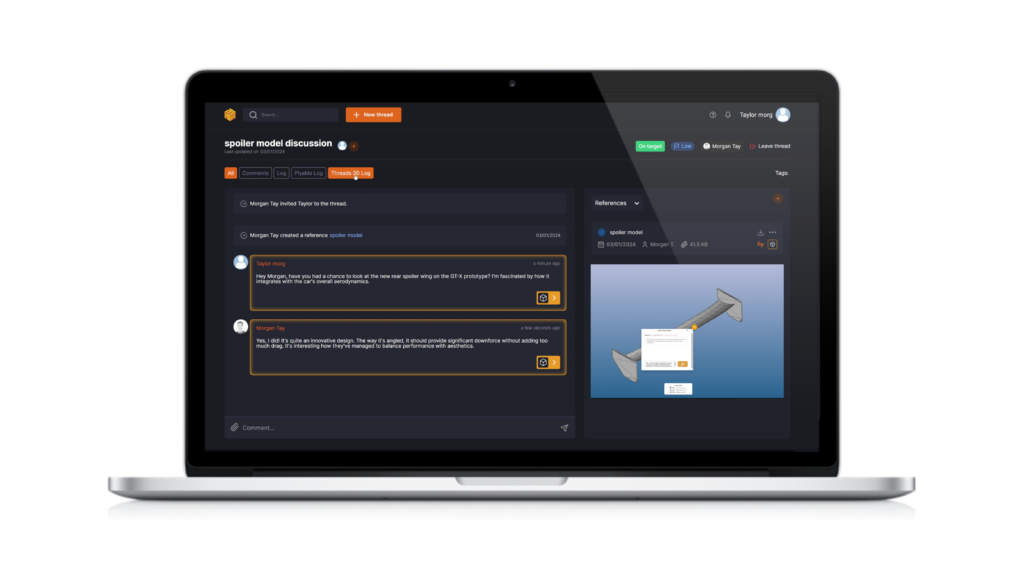
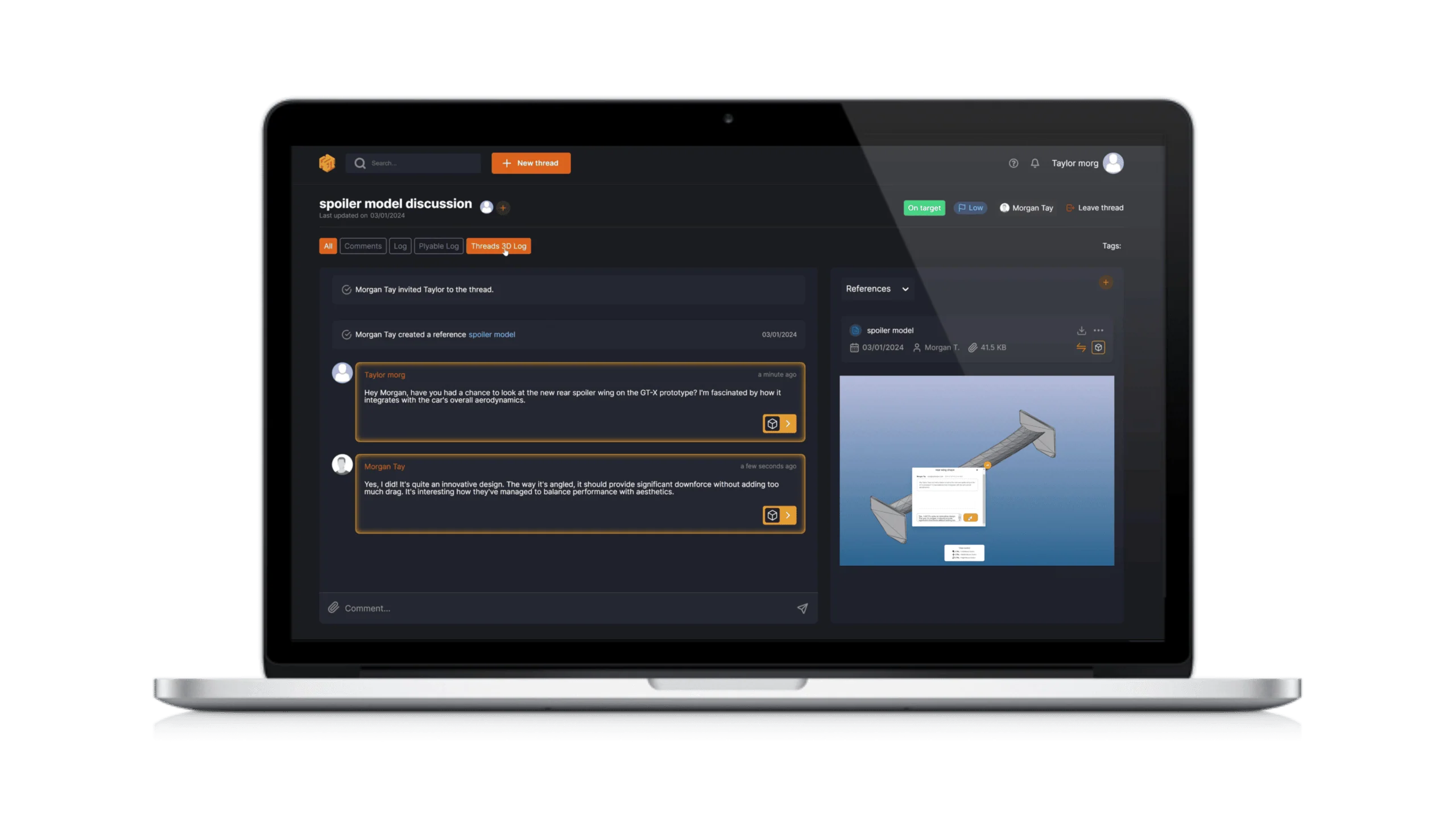
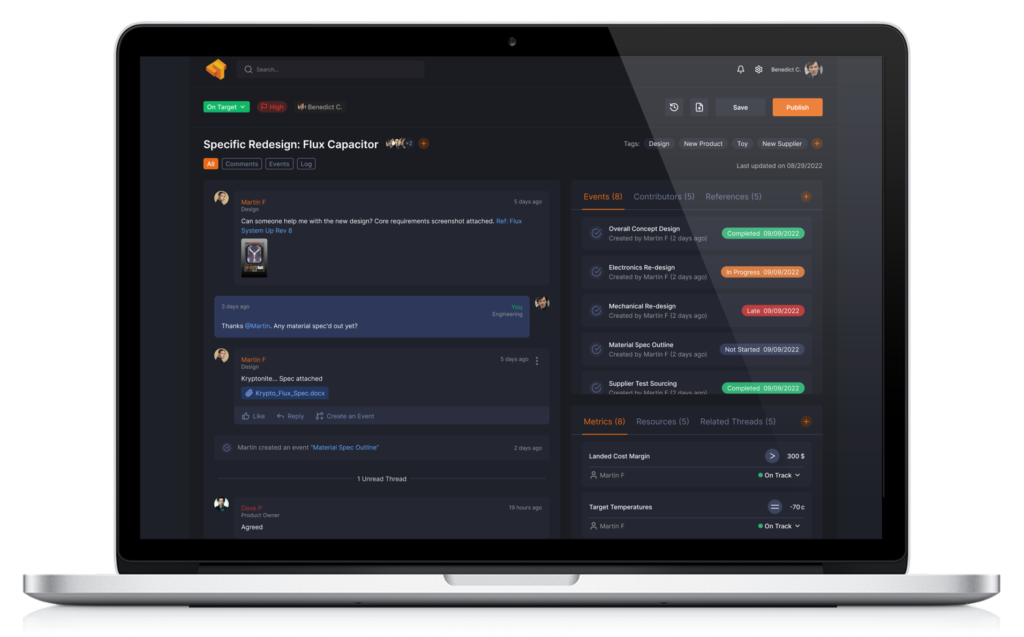
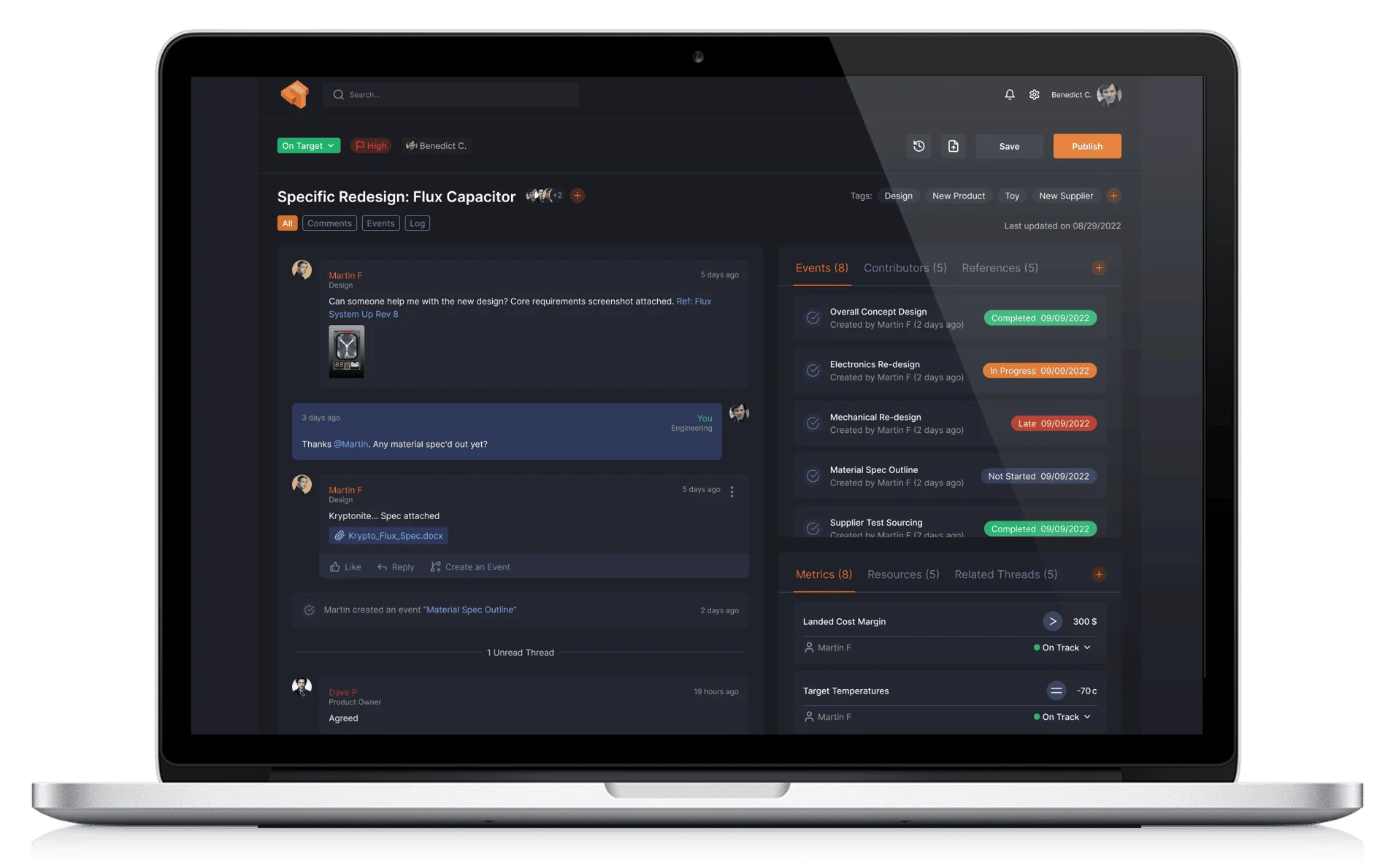
The best way to explain it is a combination of Jira, Slack, 3D model annotation, and AI. You have conversations with stakeholders in various threads. You upload documents, video call transcripts, all of it. Then AI works on top of that in two main ways. First, there’s a chatbot that lets you find out what’s going on at any time. Second, you click a button and it generates a report from the data in the threads you select, using your own templates. Additionally, Threads 3D allows adding CAD annotations.
In Boeing’s case, they estimate up to 120 hours of engineering time go into generating those reports alone. That’s not value-added engineering, it’s summarization. Bureaucratic work. We create a first draft in seconds and save 90% of that time.

And it’s still engineers doing that work, because nobody else has the project knowledge.
Right. Nobody else knows the context. So you’re using your experienced engineers for paperwork.
What’s the adoption been like?
We can see the value Threads provides for our customers. But there’s a lot of inertia around getting people to switch how they collaborate. It’s a multi-stakeholder problem. Everybody has to switch, otherwise it doesn’t work. So we’ve become very critical of any approach that requires large-scale change management.
What’s happened since we developed Threads is that AI has advanced rapidly. We think the same goals can be accomplished by agentic systems working in the background. We’re releasing something called Whisper that’s the agentic version of Threads. It lives in the tools you already use. Nobody has to touch it. Threads stays available as a front end for those who want it, but the real capability moves to the back end.
Change management’s golden rule is making everyone understand that change is inevitable. Is it not inevitable then?
That’s exactly the issue. There are people in these environments who don’t consider any change whatsoever. That inertia is deep-seated and sometimes impossible to overcome. So you put it in the back end. They don’t have to change. That’s one of the biggest learnings from working on Threads.
Boeing and the Air Force Use Threads
Your customers mention 70% fewer meetings, 2x faster development, and 31% reduced risk of mistakes. Where do those numbers come from?
Authentise is the first software company, we believe, in the history of the Department of Defense to get a prime contract, meaning we were also responsible for delivering the manufactured item.
In that project, the traditional approach to risk was a consultant-led, model-based systems engineering exercise. It costs about $100,000, only shows risk at a specific moment in time, and it’s short-lived. We also did a bottom-up approach where we ran large language models over all the collaborative project data.
Doing that, we identified twice as many risks with twice the detail compared to the traditional approach. When all your collaboration happens in one place and you can just ask a chatbot where things stand, or statuses update automatically from conversations, you start to see why meetings drop and risk goes down.
Boeing, the U.S. Air Force. How did you land them?
Boeing was our launch customer. We were part of a Boeing accelerator in 2019, and they’d used our additive manufacturing products before. It’s a relationship we’ve built over years. With Whisper, we went about it differently. We said we’re not building this until we have customers who believe in the mission and have taken some of the development risk off our shoulders. They paid for membership in a steering committee.
Do people come for the whole package or for certain capabilities?
The bigger companies come for the outcome which is efficiency that can be measured in ROI. The smaller teams, especially university teams working on robotics or race car projects, come for the collaborative environment.
What kinds of teams get the most value?
Any organization with a high number of engineering collaborators, and that includes external ones. Pretty much anyone working on projects where information tends to get lost. Everyone, basically: From large OEMs to five-person service provider teams that serve many different organizations. The key profile is an industry with compliance requirements and a stakeholder group that exceeds 20 people.
What’s the use case with external engineers?
They’re often the ones lacking context the most. In any engineering project, you have external experts in materials, simulation, testing. If those consultants have access to the intent data, they give better advice. And from the company’s side, the learnings those consultants bring in actually get retained inside the organization instead of disappearing when the engagement ends.
Any use cases you didn’t design for?
The risk analysis I mentioned earlier was completely unexpected. We started collecting the data and the Air Force was like, yeah, whatever. Then we ran it and found twice the risks. Now we’re more intentional: matching project data to internal and external standards. We can flag compliance issues early in the process rather than discovering them at the end. We want to enable companies to build their own use cases over time.
$15 a Month and the Inertia Problem
What’s the pricing like?
For Threads, we have a freemium version, 2 paid packages at $15 and $60, and an enterprise solution that needs a custom approach.
Considering the low pricing, why isn’t every team using this?
It’s not about pricing. AI is still very new in these organizations. Getting the form factor right, getting them to believe it won’t cause disruption, that’s the real challenge. The low price is a reflection of the deployment difficulty. If you can reduce those barriers, you can charge a lot more.
What does Threads integrate with?
We have deep integration with Autodesk, less so with Siemens tools right now. We can pull data from existing PLM systems. There’s a Plyable integration for mold tool analysis, and we’ve built a way for users to add their own plugins. Three or four live integrations in Threads today, and already eight or nine in Whisper before it’s even released.
From Years to Minutes
You’ve been in this space for 14 years. What’s actually changed?
The biggest change is in the last few years with AI. But industrial practices are slow to change by definition. Long sales cycles mean limited signals showing a tool’s impact, which means limited venture capital because fund cycles don’t match. At the 10,000-foot level, very little has changed in the engineering workflows.
What will the next five years look like?
I have a long-term bet from 2016 that there would be no more commercial wind tunnels by 2026. It’s 2026 and there are more than ever. So I’m not making any more predictions.
But the direction is clear. We need to reduce the time it takes to turn an idea into a part, whether that’s a spare part or a new product, from the current timeline that often extends over many years. That’s what every company in this space is working toward. I think we’ll make real headway in the next five years. How much? I won’t say.
What other AI tools in the engineering space have caught your attention?
There’s an interesting emergence of simulation tools that aren’t based on physics models but on behavior simulation. A company called 1000 Kelvin is doing that. One of their co-founders contributed to reducing the weight of a glass beer bottle by 13% using those tools. Real product, real savings.
Authentise is a workflow company. We don’t do algorithmic work. We leave that to others and provide the glue, the digital thread between tools. There’s a lot of great work happening across the verticals.
Related Topics
 seongjae oh
 8
8
 Javier López Picazo
2
Javier López Picazo
2




Comment(0)