

 Europe
  Türkiye
  United Kingdom
  Global









 Login with my Xometry account





Vincent Ung, the COO and co-founder of Cognitive Design Systems (CDS) took the time to shed light on the silo issue between design and manufacturing, how generative design is moving past 3D printing, and where AI fits into engineering work.
The Gap Between Design and Production
What is the problem you are out to solve?
The problem is that design engineering needs to be much faster. There are far more requirements on engineers to develop new products, and we need to evolve with the technology. So we are looking to accelerate cycle times for product design, especially for mechanical parts.
There is a founding team of three. Who had first-hand experience with the problem?
I do not come from mechanical engineering, I actually come from finance. But Rhushik and Henri are mechanical engineers. They worked extensively in Japan, in service bureaus, in charge of manufacturing and design, and they saw and felt the problem first-hand.
In large companies you have mechanical design on one end, then simulation and feasibility studies, and at the very end the manufacturing people on the shop floor who almost never get consulted on those designs. So they wanted to bridge that gap.
They also have a lot of experience with additive manufacturing, which spurred us on.
How does additive fit in?
Additive manufacturing gives you more freedom of design, which means that generative design outputs are feasible for production. We started out with AM but then gradually moved towards more conventional manufacturing methods.
So, we believe that generative design doesn’t have to be just for AM, it can be used for die casting, machining, injection molding, and all of that, and we can leverage those technologies for manufacturing as a whole.
You say you believe that. Does the market believe it too?
That is what we are seeing, and seems companies like InfinitiForm too. AM is still niche, and when I say AM I mean industrial 3D printing, and it is not at its full potential yet. In industries like aerospace you have a lot of certification constraints. The question is never AM versus conventional. It depends on what you need, the performance of the part, the trade-offs you can make, the quantity. Under pressure to be more productive, we need to change the way we design.
Generative design and topology optimization have existed in everyday CAD tools for a while. Why have they not solved the design-cycle problem?
With topology optimization you reduce material and put it where the stresses are highest, so you get a theoretical part. That does not mean the result is manufacturable. In Cognitive Design we do it in two steps. First you improve the performance of the part, then you run what we call manufacturing-driven design, automated design for manufacturing that redesigns the part for a given process. You couple the two to get the most out of it. And topology optimization is only one approach. We have developed our own algorithms for enclosures and for topologies that are not based on stress.
You have been in AM for some time now. Everyone agrees it enables quick iteration and in-house manufacturing, yet pickup has been slower than expected. What is holding it back?
A few things. The first is cost. Metal 3D printing is still expensive compared to die casting or machining. The second is certification, which carries its own cost on top.
Then there is maturity. Not everyone is at the same level about what AM can really do, the post-processing it needs, the design it requires. A lot of people come in thinking they will take a part designed for conventional manufacturing and just 3D print it, and sometimes it fails. People also have this shortcut in their head that 3D printing is only for cheap, rapid polymer prototyping, when we are talking about real applications. There are great use cases, but it is not fully embraced yet.
Generate the Part, Then Make It Manufacturable
So how does Cognitive Design solve all of this?
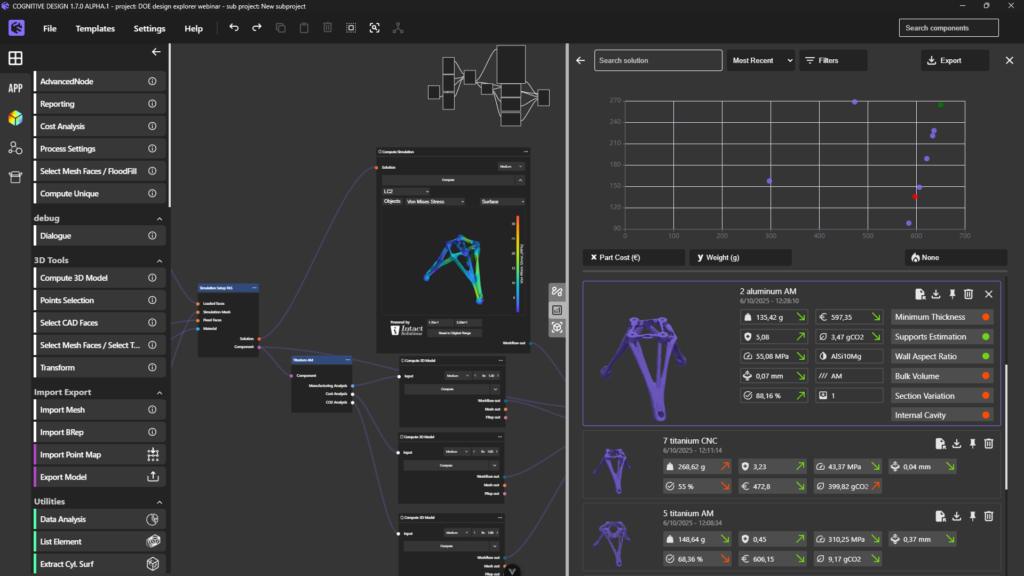
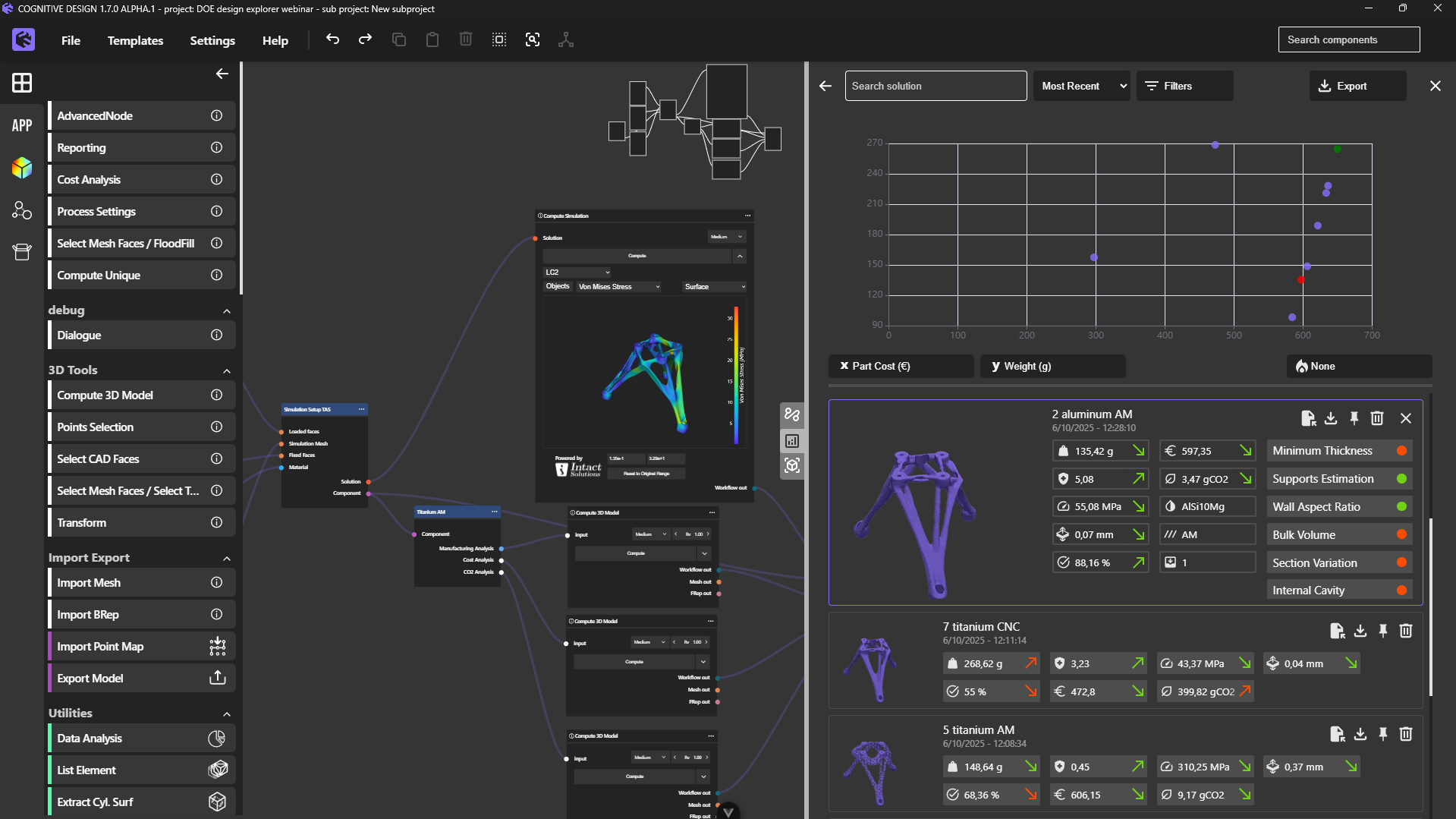
The core capability is generating multiple designs and letting you explore them. You make trade-offs based on stress, performance, cost and carbon footprint, and understand which direction is best for your needs. On top of that we use AI to go faster. Exploration that used to take a long time, because people designed those parts manually, now happens with AI.
What inputs does the human give, and who makes the first model?
As a starting point you bring an existing 3D model, an STL mesh or a STEP file, and you add your load cases if you have simulation. The software has meshless simulation built in, so we calculate the performance of the part and make sure it meets the criteria. You also get various materials, and you can import your own, so you can compare titanium versus aluminum versus Inconel across processes like AM and machining.
How do you use generative design, and what makes it fast as per your web claims?
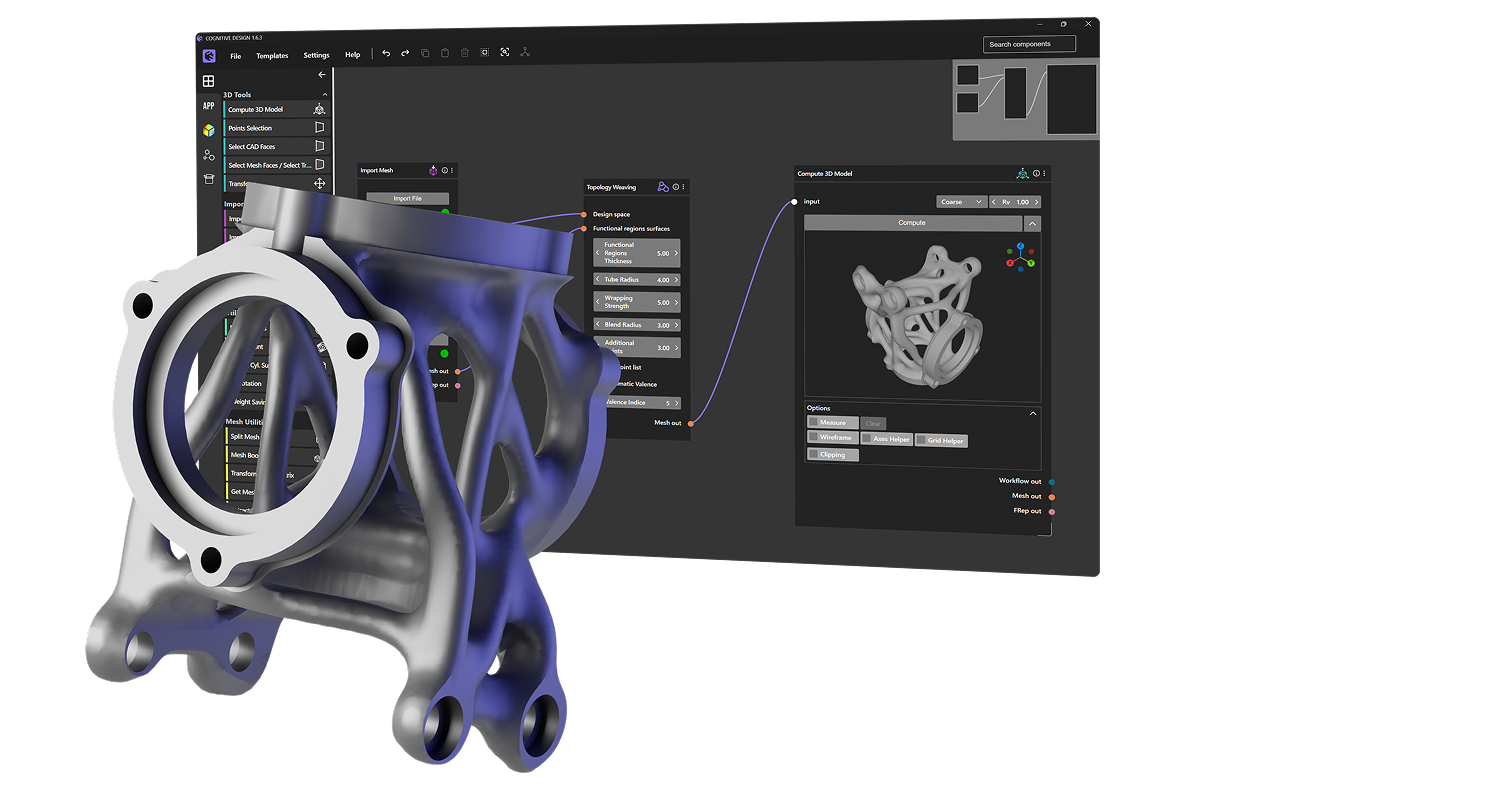
Generative design is used almost all the time. We use it for topology optimization to find the best theoretical part. We have an algorithm specifically for enclosures, a gearbox for example, and another set we call topology weaving, where you create designs that do not depend on stress, connecting functional regions along a path.
Recently we released a design of experiments, which lets you generate designs across a range of parameters. Instead of one value you say, I want this tested between 0.5 and 10, and it creates a matrix and generates a lot of designs automatically.
The speed comes from our own implicit kernel. Implicit modeling represents a 3D model by fields, similar to a company like nTop, and we do all the modification there, which is why we made the simulation meshless too. Everything runs in implicit almost to the end, where you need a mesh, and then you export a mesh or a STEP file with a reconstruction from mesh to B-rep.
The next capability is Design for Manufacturing. Tell us about that.
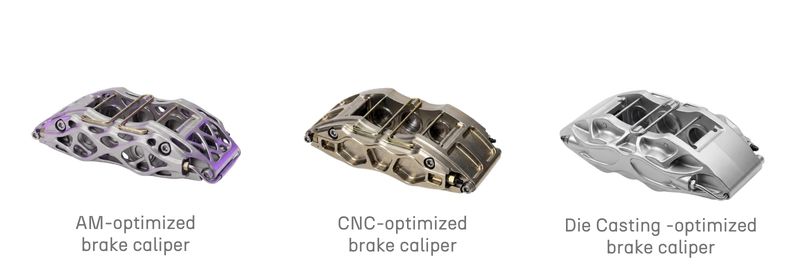
We have five main processes today: AM, machining, die casting, forging and injection molding. We take Design for Manufacturing rules and use them to modify the parts, and the particularity is that the rules are customizable. Clients bring their own internal DFM rules and apply them to the design. For a moldable part, draft angles, undercuts and wall thickness matter a lot, and the software automatically redesigns to respect those constraints.
So you provide a rule set I can edit. Is this algorithmic only or is there also an AI component to it?
This part is algorithmic, it is rule-based.
How does the flow work? First I get iterations from generative design, then I run design for manufacturing?
Yes, it is sequential, in two steps. That is actually a good differentiation compared to some existing tools, which embed manufacturing constraints into the topology optimization solver and at the end may not give you manufacturable parts. We split it because otherwise you have too many constraints at once and it does not converge well.
Taking machining as an example, very difficult designs are manufacturable but come with a price to match. How do you keep the output from becoming an expensive, over-complex part?
On machining we currently only have 3 axes, but you are right, machining can get complex. We generate more prismatic parts, and you can define directions in x, y and z, so the result is more machining-friendly. You are not forced into the most expensive, most complex part, even though you could do that in machining.
We also give you costing to guide those choices, and it works the same way as DFM, configurable by the client – the wages, the hourly rates, the price of the machine, the material. The idea is not to calculate the cost to the nearest cent, it is to understand whether machining beats another process and the order of magnitude of the price difference.
What’s simulation-driven design?
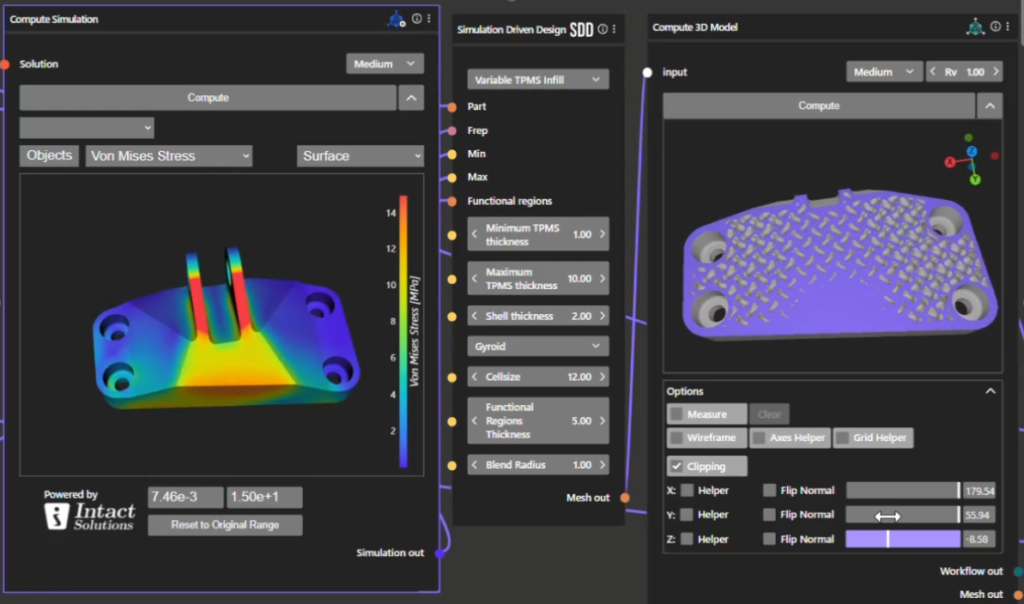
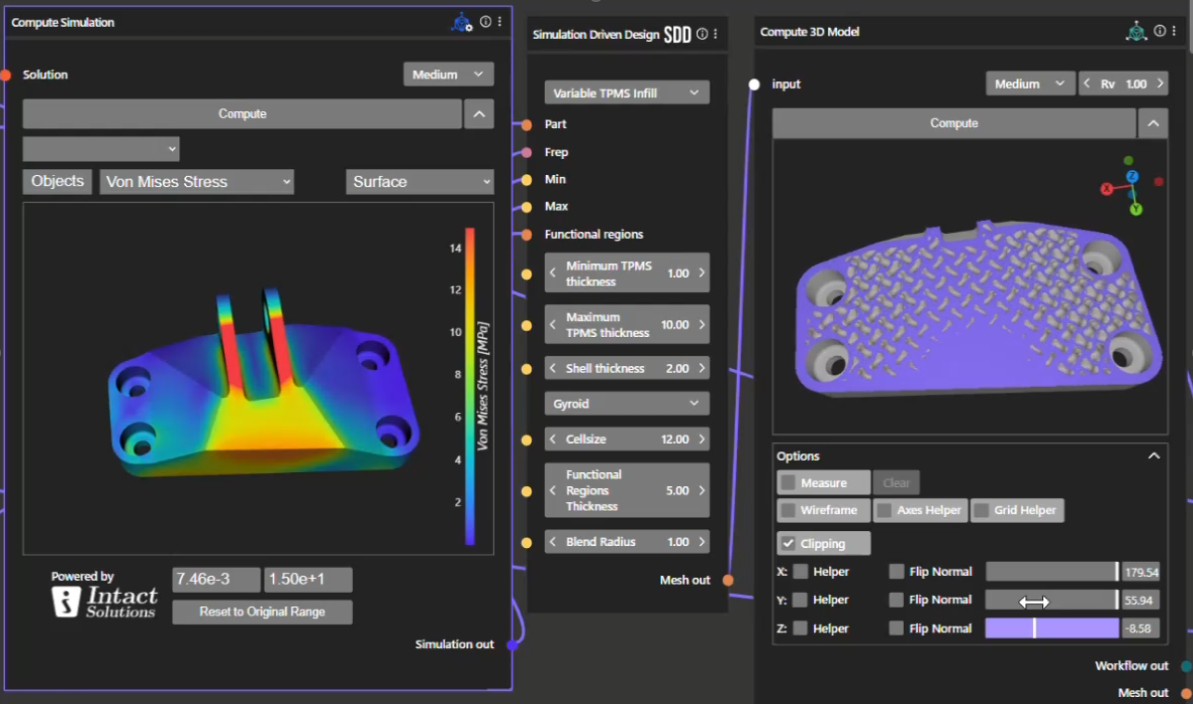
We do mechanical and thermal simulation to validate the parts and make sure they meet the requirements, then use the stress data to optimize further. You add material where there is a lot of stress and remove it where there is less. In AM you can place lattices or TPMS structures based on stress levels, do offsets, add ribbing. You can also import stress data from an external solver like Ansys, Abaqus or Nastran, and we read those results and modify the geometry accordingly.
So it becomes a loop.

Exactly. The idea is a loop between all those elements. Once you have created your workflow, you can run it on a lot of different parts, changing parameters or boundary conditions to generate the designs.
When the computer is doing so much already, the engineer still has to understand it. After ten good results, won’t engineers just start trusting the software blindly?
Most engineers use our software to converge to the best concept as fast as possible, then validate at the end in a certified tool like Ansys. Ansys can take hours or even days, so the point is they do not iterate in it, they only run it once at the end, when they have already converged to the best theoretical part.
What does the reusable workflows feature mean on your website?
As you use the software you build a workflow, basically a methodology or design knowledge you understand as an engineer. You package it, send it to another team, and they reuse the inputs and outputs to get a similar result with different data. You encapsulate the knowledge of both manufacturing and design engineers. That is what I meant about bridging the gap between them, and all of that knowledge stays internal to the company.
What is AI here?
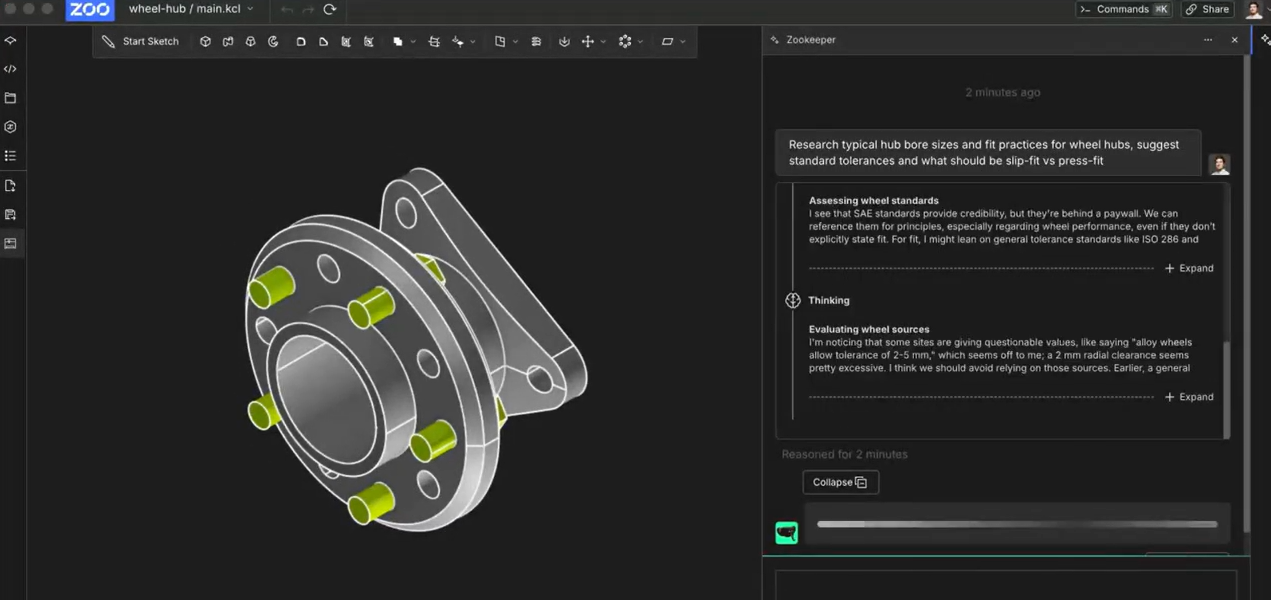
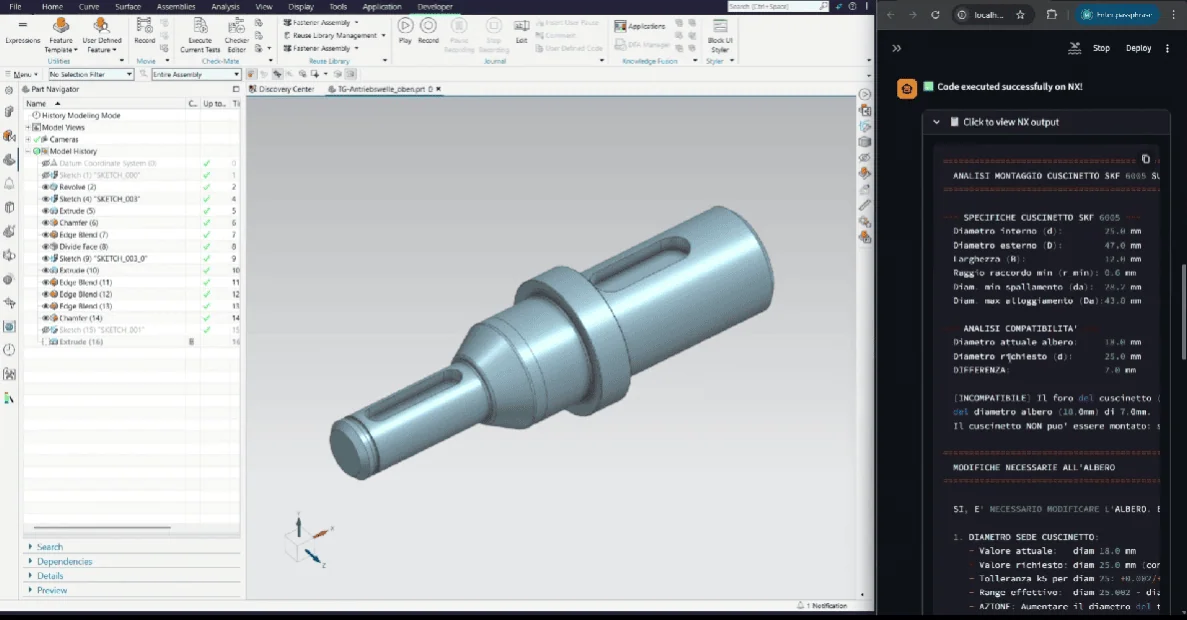
We use it a few ways, and not the same way as others. Sometimes to estimate cost faster, sometimes for feature recognition, for example recognizing cylinders and surfaces when we reconstruct a mesh to B-rep. But most importantly, we integrate with existing LLMs. We have done integrations with Claude and others, we are agnostic. Instead of using the interface, you can stay in your LLM and say, here is the folder with my parts, optimize for machining, die casting and AM, give me a design of experiments across materials, here are the load cases in my Excel, run. The LLM is integrated as an MCP server, so it has the context and can use the software autonomously, almost as if it creates the workflow itself.
You started in 2021. How much AI would there be if you started in 2025 or 2026?
Similar, because our position is that AI is an enabler. You are not removing the human, you are accelerating decision-making so you can explore more design variants. I do not believe engineers get replaced. You get much more efficient, smaller teams producing more, and we already see that. The days where someone was an expert because they knew CATIA for 20 years and which buttons to click are gone. You do not define an engineer by their ability to use a software, but by how they make decisions from their knowledge and their results.
It seems to me the further founders are from engineering, the more certain they are that AI will do autonomous engineering. The engineering founders say AI helps by accelerating the engineers’ work, mostly by removing some tedious flows and repetitive tasks.
We are on that side. Two of the founders are mechanical engineers, and we have a lot of engineers, not just design but manufacturing, so we understand the real-life constraints of machines and production. Even with heavy automation you need a human to validate, for regulation and to make sure the calculation is right, because AI can hallucinate. In a very sensitive industry, I do not see how EASA approves an AI part that was never simulated in Ansys or another certified tool. There are companies doing AI simulation, predictions instead of actual calculations, which is great for exploring variants and converging on the best one. But I do not see us removing the FE calculation at the end. It stays a tool that needs to be validated.
Serving Aerospace, Defense and Automotive OEMs
Who are you for?
We gravitate towards three main industries, aerospace, defense and automotive, and we serve large OEMs. Our biggest client today is Safran, in aerospace. Two of the founders were based in Japan, so we have strong ties with Japanese customers, mostly automotive and space, while in France it is mostly defense and aeronautics. The company is based in Toulouse, the home of Airbus, so there are a lot of suppliers and big aeronautics players around.
How many companies use the software today?
Between 60 and 70.
Can you give an example of a client putting this to work?
A good one is Thales Alenia Space. They make brackets for satellites and had a family of around 80 to design, with different combinations, topologies and shapes, all done manually before. With our software they built a workflow that optimizes each shape, checks whether it is better in AM or machining, and which material is best. Once they had done it for one bracket, they automated the whole family, because the load cases were similar and it is parametric, so you reuse the work from the first part. It works particularly well when you have a family of similar parts or want to reuse a methodology across parts.
What is the most satisfying kind of win for you?
As engineers, we love to see parts. The purpose of CDS is to go from design to a real manufactured part, so we love it when a client sends us pictures of something they actually made from a design in our software. The ROI is efficiency, going from hundreds of hours to dozens, and sometimes clients reach a performance they simply could not with their existing tools.
On-Premise by Choice
What does Cognitive Design cost, and how do you price it?
It is a SaaS license, but the software is on-premise, which is a real advantage. There is no cloud connectivity, so the data stays proprietary. We have fixed and floating licenses, and the price range is around 10 to 20k euros depending on the license and the module.
The on-premise requirement came from the industries you serve, aerospace?
Yes, and it was a conscious choice. We could deploy on the cloud, but it would stop a lot of our clients from using the solution.
Can I pay for limited functionality, like just generative design or design for manufacturing?
Yes, we have a few packages depending on the module, but most clients go for the full package.
How long does the setup take from the day I sign to the first engineer using it?
Usually a few days. For some companies there are cybersecurity and IT restrictions, but it is like installing an application on your desktop. We do server deployments for larger clients with more than one license, and floating licenses so you can have concurrent users.
How much support do you provide?
We always provide support, and onboarding is key because it is a new way of designing. The software is very user-friendly. You connect blocks with connectors, similar to Grasshopper or Rhino if you have done parametric design that way. Within a day or two you are independent, and we support clients as they become more extensive users of the platform.
Does it integrate with the CAD and PLM tools teams already use?
We would love to. It is not always easy to work with other editors, because CAD companies are very protective of their PLM, which is really the heart of it, when you think of Dassault Systemes or Siemens. There are solutions from companies like Tech Soft 3D to connect to those PLMs, and it is something we are looking at. We want to be more integrated into the engineering workflow, because large companies need interoperability and, more importantly, traceability with PLM.
So today if I am on SolidWorks, I export a STEP file, use your software, and re-import?
Yes, optimize and then re-import the STEP file into your CAD software at the end.
The Next Five Years
What will design engineering look like in five years?
More and more engineers will use software that makes them efficient. Generative design will definitely stay, and AI physics-based approaches will be complementary to the suites people already use, to validate, to generate, to be more productive. Today there are only three main suites, Dassault, Siemens, and PTC or Autodesk, covering everything from CAD to CAE to PLM to MES and ERP. Large companies will find it hard to move away from that stack, so we sit alongside it. I also think there will be a lot of consolidation, with large and mid-sized players integrating more functionality. What is interesting is whether an AI company makes that move and competes with the software editors, whether Anthropic one day positions itself as an engineering tool. They have entered a lot of verticals through acquisitions, so they could disrupt these industries the same way.
What is one thing the industry is underestimating and one it is overestimating about AI?
It is a tricky question. I think we are underestimating the pace at which AI is progressing. The older models were like a graduate with basic physics knowledge, and with newer models the reasoning is a lot deeper and more complex.
On the other side, we are overestimating our own capacity to digest it. AI keeps coming up with new things, and as humans our adaptation to new technology is a lot slower than what the machines are capable of, especially in this industry.
Many of the AI companies in this space seem to be on friendly terms, even talking about cooperation, which is not always the case with startups. How optimistic are you about bringing those solutions together?
Honestly, most founders of engineering software know each other, so we are on friendly terms even as competitors. We know we cannot do everything ourselves, and in the end we want to make engineers’ lives better. Nobody wants one software for CAD, another for PLM, another for MES and simulation. You want one platform that encapsulates everything, which is why we talk about complementarity. And with AI and LLMs, interoperability is much less of a bottleneck. An LLM agent connects through MCP servers to a lot of different tools, so you do not import and export your 3D model between them, the agent does it for you. You could imagine AI companies as the core, connecting to different software, with the agent doing the tedious work that added little value.
Any interesting AI companies in design or manufacturing you would highlight?
A few. Last week we were talking with PhysicsX. We know Neural Concept and Synera quite well. There is InfinitiForm, doing something similar to us. It is still the very beginning, and it will be interesting to see whether some of these startups end up complementing each other to compete with the big players like Dassault and Siemens.
Related Topics
 Javier López Picazo
 2
2
2
2



Comment(0)