 Europe
  Türkiye
  United Kingdom
  Global








 Login with my Xometry account
Quick Design Reference for 3D Printing
This brief overview of design features and process specifications is created to help you:
- Design your parts efficiently.
- Compare different 3D printing processes to determine which technology best suits your design.
- Maintain functionality while improving the quality and durability of your parts.
This quick guide is a summary of further sections. You can interactively choose processes to compare and see feature sizes and limitations achievable with each 3D printing process. Further sections provide detailed explanations about each feature for every process.
Comparison Table
 in the side menu.
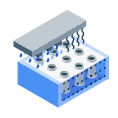 MJF
MJF
HP Multi Jet Fusion
 SLS
SLS
Selective Laser Sintering
 FDM
FDM
Fused Deposition Modeling
 SLA
SLA
Stereolithography
 Polyjet
Polyjet
 Carbon DLS
Carbon DLS™
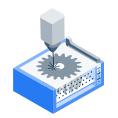 DMLS
DMLS
Direct Metal Laser Sintering
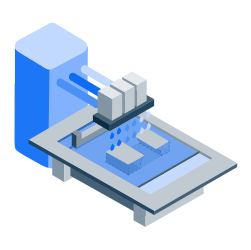 MBJ
MBJ
Metal Binder Jetting
Description Multi Jet Fusion (MJF) 3D printing is one of the most widely used industrial additive manufacturing processes. Like SLS, MJF is used to produce strong, functional plastic parts. |
Best Use Case Strong and functional prototypes & low-volume production |
 Maximum Part Size 380 × 284 × 380 mm |
 Minimum Part Size 0.0 × 0.0 × 0.0 mm |
Description Selective Laser Sintering (SLS) 3D printing is one of the most widely used industrial additive manufacturing processes. Like MJF, SLS is used to produce strong, functional plastic parts. |
Best Use Case Strong and functional prototypes & low-volume production |
Maximum Part Size 700 × 380.0 × 580.0 mm |
Minimum Part Size 12.7 × 7.5 × 2.54 mm |
Description Fused Deposition Modeling (FDM) 3D printing is cost-effective and widely known for its great material selection, accuracy, and the possibility to print large, functional plastic parts. |
Best Use Case Affordable & large format prototypes and end-use parts |
Maximum Part Size 900 × 600 × 900 mm |
Minimum Part Size 5 × 5 × 0.75 mm |
Description Stereolithography (SLA) 3D printing utilizes light-curable thermoset resins to build highly accurate, high-resolution parts. Its surface finish is one of the highest standards in the industry and recommended for aesthetic prototypes. |
Best Use Case Visual prototypes with high resolution |
Maximum Part Size 736 × 635 × 533 mm |
Minimum Part Size 3 × 2 × 1 mm |